

Meta to cut 10 percent of workforce while Microsoft offers voluntary buyouts in the US

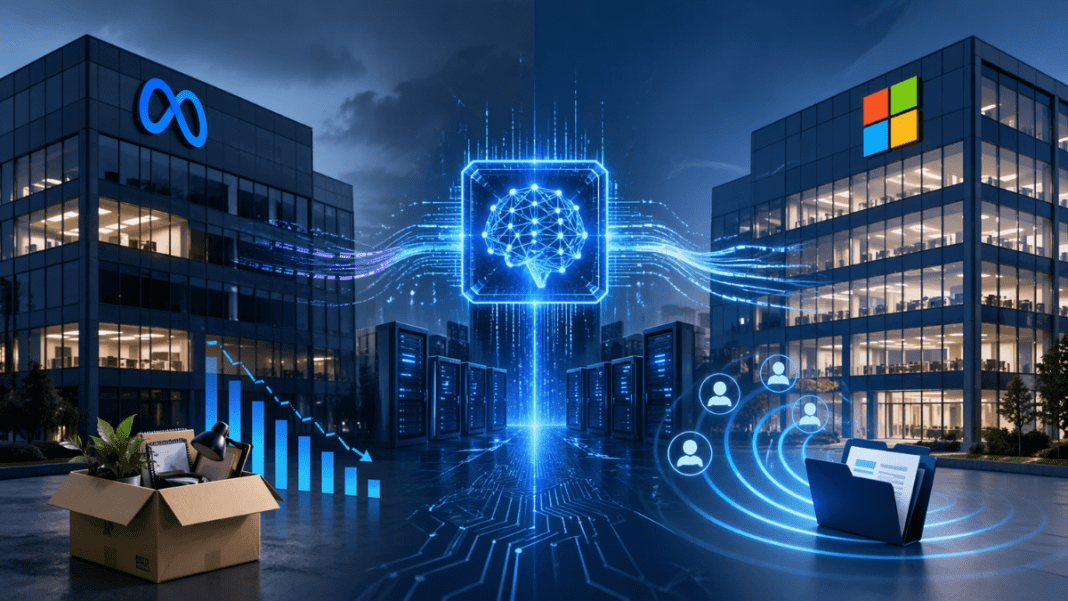
Two of the world’s largest technology companies are making major changes to their workforce. Meta has announced that it will lay off about 8,000 employees, which is nearly 10 percent of its total workforce. At the same time, Microsoft is offering voluntary buyouts to around 8,750 employees in the United States, or about 7 percent of its US workforce.

These announcements came on the same day and highlight a growing shift across the technology industry. Companies are adjusting their workforce as they increase spending on artificial intelligence and related technologies.

Meta said the layoffs are part of a plan to improve efficiency and allow more investment in key areas of its business. Reports also indicate that the company will leave around 6,000 roles unfilled. This shows that Meta is not only cutting jobs but also slowing hiring.

Microsoft is taking a different approach. Instead of direct layoffs, it is offering buyouts that allow employees to leave voluntarily with financial support. These offers are expected to be made in early May. The aim is to reduce the workforce in a more gradual way.

A memo from Microsoft’s chief people officer, Amy Coleman, explained that the program is designed to give eligible employees the choice to move forward on their own terms, with company support.

Washington Post cuts nearly one-third of staff in sweeping newsroom layoffs

Rising Costs and Heavy Investment in AI

The main reason behind these workforce changes is the rising cost of artificial intelligence. Both companies are investing heavily in building and expanding AI systems. This includes spending on data centers, infrastructure, and highly skilled employees.

Meta has already informed investors that its expenses for 2026 will increase significantly. The company expects total spending to reach between $162 billion and $169 billion. A large portion of this will go toward infrastructure and employee compensation, especially for AI experts who are being hired at very high salaries.

Meta is also expanding its physical infrastructure. The company recently started building a new AI-optimized data center in Tulsa, Oklahoma. This project is valued at $1 billion and will become its 28th data center in the United States.

Microsoft is also investing billions in its global network of data centers. These centers support cloud computing services, artificial intelligence systems, and productivity tools like its AI assistant, Copilot.

Such large investments require companies to carefully manage costs while continuing to grow their AI capabilities.

Inside the Washington Post’s looming newsroom shake-up as layoffs and cuts deepen

Industry Shift Toward Efficiency and Automation

The actions taken by Meta and Microsoft reflect a wider shift in the technology sector. There is an increasing focus on efficiency and automation. AI tools can now perform tasks that previously required large teams of employees.

As a result, companies are restructuring their workforce. Some roles are being reduced, while demand is growing for workers with advanced AI skills. This shift is leading to leaner organizations that aim to maintain productivity with fewer employees.

Industry analysis supports this trend. Dan Ives noted that companies are using AI tools to automate tasks, reduce costs, and streamline operations. This allows them to maintain productivity while moving toward a more efficient structure.

Microsoft’s buyout plan offers employees flexibility by allowing them to choose whether to leave. In contrast, Meta’s approach involves direct layoffs and unfilled roles. Both strategies are aimed at reducing workforce size while shifting focus toward AI investments.

These announcements also affected the stock market. Meta’s stock fell by 2.3 percent, while Microsoft’s stock dropped by 3.97 percent on the same day.

The developments show how major technology companies are adjusting their workforce and spending as artificial intelligence becomes a central part of their operations.

T U Deshmukh
T U Deshmukh
T U Deshmukh is the leading voice on the subject of Jobs, AI, Data and layoffs and she regularly contributes a column on Jobs for Newsinterpretation.

TOP 10 TRENDING ON NEWSINTERPRETATION

Cyber Attacks on Space Infrastructure: Satellites, GPS and the Ground Systems Behind Them

From the Viasat KA-SAT hack to GPS jamming over the Baltic, a research guide to how attackers target satellites, navigation signals and ground stations, and why it matters on Earth.

How AI Agents Are Used in Cyber Attacks: From Assisted Hacking to AI-Orchestrated Espionage

Attackers now use AI agents to scan networks, write exploits and run extortion campaigns. A research guide to documented cases, including the first reported AI-orchestrated espionage campaign, and what defenders should do.

Cyber Attacks on AI and LLMs: How Attackers Target Large Language Models

Prompt injection, data poisoning, model theft and jailbreaks: a research guide to how attackers target AI systems and large language models, with real cases and defences.

French Supermarket Refrigeration Cyberattack: How Hacking the Cold Chain Can Endanger Lives

In October 2026 attackers heated refrigeration cabinets in hundreds of French supermarkets to as much as 50°C. No one was hurt, but the attack shows how hacking the cold chain can endanger lives through fire, food poisoning and spoiled medicines.

Cyberattacks on Nuclear Facilities: Stuxnet, Kudankulam and the Limits of Air Gaps

Stuxnet, the Davis-Besse worm and malware at India’s Kudankulam plant: what they show about cyber risk at nuclear facilities and the limits of air gaps.

Triton: When Hackers Target the Safety Systems That Prevent Industrial Disasters

The 2017 Triton attack targeted the safety systems that prevent industrial disasters. What happened, who was charged, and how plants protect their last line of defence.

Cybersecurity Risks in Smart Cities: When Connected Infrastructure Fails

How connecting traffic control, emergency alerts and utilities concentrates cyber risk in cities, what the Dallas and Atlanta incidents showed, and what governments recommend.

Weaponized Drones: Hijacking, GPS Spoofing and Emerging Cyber Warfare Risks

How drones can be hijacked, jammed or misled by GPS spoofing, what researchers have demonstrated, and why governments treat drone fleets as a security risk.

Ransomware Attacks on Hospitals: How Healthcare Cyberattacks Put Patients at Risk

How ransomware against hospitals and their suppliers delays care and endangers patients, what the Düsseldorf and WannaCry cases show, and what research says about deaths.

Operational blunder exposes massive Russian cyber espionage attack on Ukrainian prosecutors

A major cyberattack has compromised the email accounts of...

Cyber Attacks on Space Infrastructure: Satellites, GPS and the Ground Systems Behind Them

From the Viasat KA-SAT hack to GPS jamming over the Baltic, a research guide to how attackers target satellites, navigation signals and ground stations, and why it matters on Earth.

French Supermarket Refrigeration Cyberattack: How Hacking the Cold Chain Can Endanger Lives

In October 2026 attackers heated refrigeration cabinets in hundreds of French supermarkets to as much as 50°C. No one was hurt, but the attack shows how hacking the cold chain can endanger lives through fire, food poisoning and spoiled medicines.

Cyberattacks on Nuclear Facilities: Stuxnet, Kudankulam and the Limits of Air Gaps

Stuxnet, the Davis-Besse worm and malware at India’s Kudankulam plant: what they show about cyber risk at nuclear facilities and the limits of air gaps.

Triton: When Hackers Target the Safety Systems That Prevent Industrial Disasters

The 2017 Triton attack targeted the safety systems that prevent industrial disasters. What happened, who was charged, and how plants protect their last line of defence.

Cybersecurity Risks in Smart Cities: When Connected Infrastructure Fails

How connecting traffic control, emergency alerts and utilities concentrates cyber risk in cities, what the Dallas and Atlanta incidents showed, and what governments recommend.

Ransomware Attacks on Hospitals: How Healthcare Cyberattacks Put Patients at Risk

How ransomware against hospitals and their suppliers delays care and endangers patients, what the Düsseldorf and WannaCry cases show, and what research says about deaths.

FBI warns of AVrecon malware targeting outdated routers linked to proxy based cybercrime

A serious cybersecurity warning has been issued regarding commonly...

Related Articles

Popular Categories
