

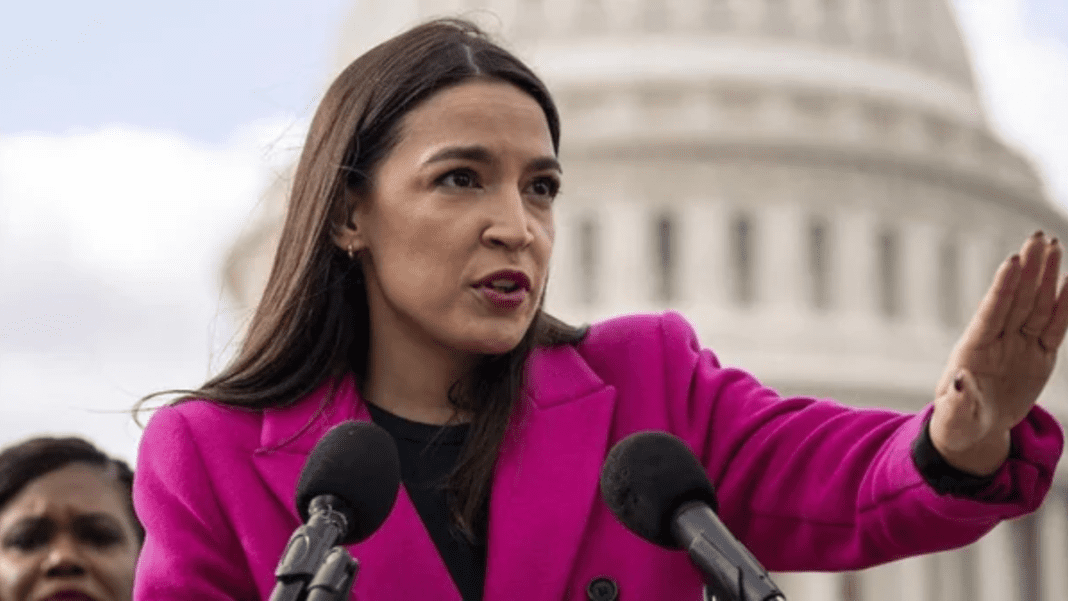
AOC backs move to bar Congress families from trading stocks to rebuild public confidence

In a rare moment of unity, lawmakers from very different political sides have come together to back a new proposal.

A rare bipartisan push to stop stock trading

The legislation aims to stop members of Congress and their families from trading individual stocks. The bill has been introduced with the name Restore Trust in Congress Act by Democratic Representative Seth Magaziner and Republican Representative Chip Roy.

The support for this measure comes from an unusual mix of progressives and conservative representatives. While these two groups often clash on most issues, they share a strong belief that elected officials should not use their positions to benefit financially from stock markets.

The move has drawn public attention because it suggests that corruption and conflict of interest in politics have become concerns for both sides. The law bars anyone serving in Congress and their close relatives from trading individual company shares. Lawmakers aim to restore faith in their decisions and ensure votes are not influenced by personal financial interests.

Strong warnings from supporters of the ban

During the announcement of the bill, Alexandria Ocasio-Cortez (AOC) warned that people who find this proposal unfair may not be suited to serve in Congress. She argued that representatives should be ready to focus fully on public service, rather than protecting their personal investments.

She described it as “outrageous” that some lawmakers see the stock-trading ban as a heavy burden. Moreover, she pointed out that Congress has too few members from working-class backgrounds. By banning stock trading, she believes the system would become fairer, giving more ordinary people the chance to enter politics without competing against wealthy insiders.

Cyberattack Catastrophe: How Hackers Can Endanger Human Lives ?

Another lawmaker Tim Burchett from the conservative side expressed frustration about how members of Congress have enriched themselves while holding office. He called for an immediate end to such practices, saying it was long overdue.

Pramila Jayapal also stressed how important it is for citizens to trust that their representatives are not thinking about their private stock portfolios when they vote. Voters want confidence that decisions are made for the people, not for personal gain.

The bipartisan nature of this movement is unusual. One Republican representative noted that support for the ban is overwhelming, with only a small minority in Congress resisting the proposal. He even claimed that lawmakers most deeply involved in active stock trading might be the ones opposing it.

Calls to expand the measure further

While the bill currently focuses only on Congress, the debate opened the door to bigger questions. Some lawmakers argued that the president and vice president should also face similar restrictions. At the moment, they are not covered by the proposal.

One of the bill’s sponsors suggested that support for including the top executive leaders could come later. He said lawmakers from both parties might add it through an amendment or introduce it as a separate bill if enough of them agree.

Harris zero votes in New York districts sparks lawsuit as Trump gains face new scrutiny

For now, the Restore Trust in Congress Act stands as a rare show of bipartisan cooperation. The proposed law has gained momentum because it speaks to a basic issue of fairness and trust in democracy. Supporters say it is not about party politics but about ensuring lawmakers make decisions free from financial conflicts.

If passed, the measure would require members of Congress and their families to divest from individual stocks and avoid trading while in office. The aim is clear: to rebuild public confidence in the people elected to represent them.


Renuka Bangale
Renuka Bangale
Renuka is a distinguished Chartered Accountant and a Certified Digital Threats Analyst from Riskpro, renowned for her expertise in cybersecurity. With a deep understanding of cybercrimes, malware, cyber warfare, and espionage, she has established herself as an authority in the field. Renuka combines her financial acumen with advanced knowledge of digital threats to provide unparalleled insights into the evolving landscape of information security. Her analytical prowess enables her to dissect complex cyber incidents, offering clarity on risks and mitigation strategies. As a key contributor to Newsinterpretation’s information security category, Renuka delivers authoritative articles that educate and inform readers about emerging threats and best practices.

TOP 10 TRENDING ON NEWSINTERPRETATION

Cyber Attacks on Space Infrastructure: Satellites, GPS and the Ground Systems Behind Them

From the Viasat KA-SAT hack to GPS jamming over the Baltic, a research guide to how attackers target satellites, navigation signals and ground stations, and why it matters on Earth.

How AI Agents Are Used in Cyber Attacks: From Assisted Hacking to AI-Orchestrated Espionage

Attackers now use AI agents to scan networks, write exploits and run extortion campaigns. A research guide to documented cases, including the first reported AI-orchestrated espionage campaign, and what defenders should do.

Cyber Attacks on AI and LLMs: How Attackers Target Large Language Models

Prompt injection, data poisoning, model theft and jailbreaks: a research guide to how attackers target AI systems and large language models, with real cases and defences.

French Supermarket Refrigeration Cyberattack: How Hacking the Cold Chain Can Endanger Lives

In October 2026 attackers heated refrigeration cabinets in hundreds of French supermarkets to as much as 50°C. No one was hurt, but the attack shows how hacking the cold chain can endanger lives through fire, food poisoning and spoiled medicines.

Cyberattacks on Nuclear Facilities: Stuxnet, Kudankulam and the Limits of Air Gaps

Stuxnet, the Davis-Besse worm and malware at India’s Kudankulam plant: what they show about cyber risk at nuclear facilities and the limits of air gaps.

Triton: When Hackers Target the Safety Systems That Prevent Industrial Disasters

The 2017 Triton attack targeted the safety systems that prevent industrial disasters. What happened, who was charged, and how plants protect their last line of defence.

Cybersecurity Risks in Smart Cities: When Connected Infrastructure Fails

How connecting traffic control, emergency alerts and utilities concentrates cyber risk in cities, what the Dallas and Atlanta incidents showed, and what governments recommend.

Weaponized Drones: Hijacking, GPS Spoofing and Emerging Cyber Warfare Risks

How drones can be hijacked, jammed or misled by GPS spoofing, what researchers have demonstrated, and why governments treat drone fleets as a security risk.

Ransomware Attacks on Hospitals: How Healthcare Cyberattacks Put Patients at Risk

How ransomware against hospitals and their suppliers delays care and endangers patients, what the Düsseldorf and WannaCry cases show, and what research says about deaths.

Operational blunder exposes massive Russian cyber espionage attack on Ukrainian prosecutors

A major cyberattack has compromised the email accounts of...

Cyber Attacks on Space Infrastructure: Satellites, GPS and the Ground Systems Behind Them

From the Viasat KA-SAT hack to GPS jamming over the Baltic, a research guide to how attackers target satellites, navigation signals and ground stations, and why it matters on Earth.

French Supermarket Refrigeration Cyberattack: How Hacking the Cold Chain Can Endanger Lives

In October 2026 attackers heated refrigeration cabinets in hundreds of French supermarkets to as much as 50°C. No one was hurt, but the attack shows how hacking the cold chain can endanger lives through fire, food poisoning and spoiled medicines.

Cyberattacks on Nuclear Facilities: Stuxnet, Kudankulam and the Limits of Air Gaps

Stuxnet, the Davis-Besse worm and malware at India’s Kudankulam plant: what they show about cyber risk at nuclear facilities and the limits of air gaps.

Triton: When Hackers Target the Safety Systems That Prevent Industrial Disasters

The 2017 Triton attack targeted the safety systems that prevent industrial disasters. What happened, who was charged, and how plants protect their last line of defence.

Cybersecurity Risks in Smart Cities: When Connected Infrastructure Fails

How connecting traffic control, emergency alerts and utilities concentrates cyber risk in cities, what the Dallas and Atlanta incidents showed, and what governments recommend.

Ransomware Attacks on Hospitals: How Healthcare Cyberattacks Put Patients at Risk

How ransomware against hospitals and their suppliers delays care and endangers patients, what the Düsseldorf and WannaCry cases show, and what research says about deaths.

FBI warns of AVrecon malware targeting outdated routers linked to proxy based cybercrime

A serious cybersecurity warning has been issued regarding commonly...

Related Articles

Popular Categories
