

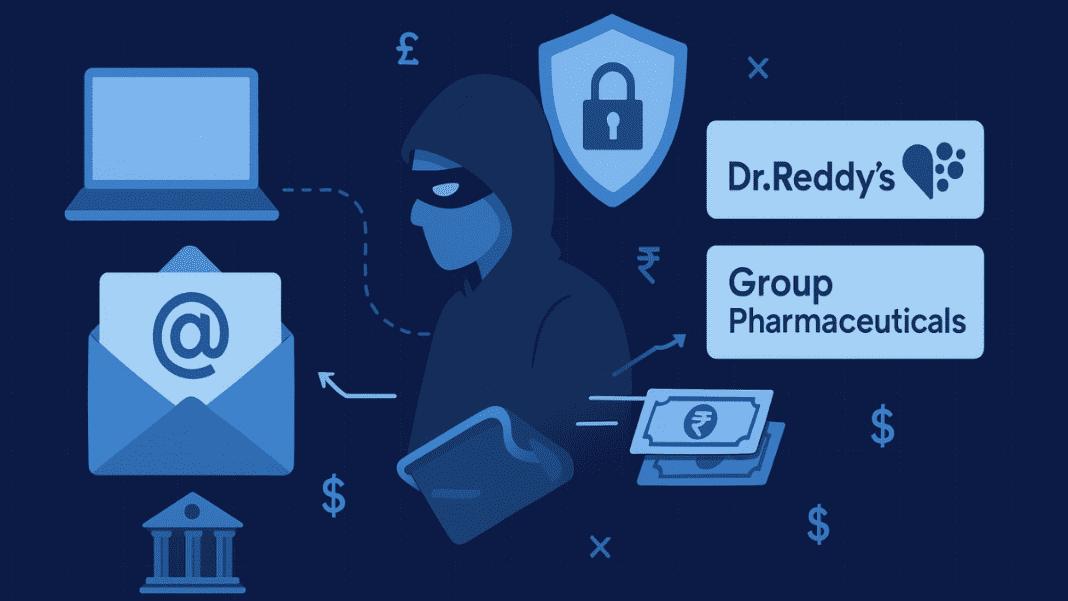
Digital double-cross — hackers loot Rs.21.6 million from Dr Reddy’s in shocking email cloning scam

A shocking case of cyber fraud has come to light in Bengaluru, where leading pharmaceutical company Dr Reddy’s c lost over Rs 2.16 crore to online fraudsters. The cybercriminals managed to infiltrate an official email thread and cleverly rerouted a payment meant for another company into a fake bank account.

According to the Bengaluru Cyber Crime Police, the fraud took place after hackers broke into the email communication between Dr Reddy’s Laboratories and Group Pharmaceuticals. The two companies were in the middle of a regular business transaction, with Dr Reddy’s due to make a payment for goods already supplied by Group Pharmaceuticals.

The incident came to light when the expected payment failed to reach its destination. Officials from Group Pharmaceuticals, including senior executive Mahesh Babu K, soon realized that something was wrong and approached the Cyber Crime Police Station in Bengaluru to file a formal complaint.

The fraud amount, Rs 2.16 crore, was supposed to be transferred by Dr Reddy’s to Group Pharmaceuticals. However, hackers pretending to be representatives of Group Pharmaceuticals tricked Dr Reddy’s into sending the payment to a fraudulent bank account.

How the Cyber Scam Unfolded

Investigators revealed that the email breach occurred on November 3. The hackers gained unauthorized access to the official communication thread between the two companies. Once inside, they closely monitored the ongoing conversation and waited for the right moment to strike.

Cyber Toufan strikes again —secret data on Iron Dome, Jericho missiles, and Australia’s Land 400 project exposed

Disguising themselves as officials from Group Pharmaceuticals, the fraudsters sent an email to the finance and accounts team at Dr Reddy’s Laboratories. The email appeared genuine as it was part of the same thread that had been used earlier for legitimate discussions. In that email, the hackers provided new bank account details and requested that the payment be made to that account instead of the regular one.

Unaware of the deception, the finance team at Dr Reddy’s processed the payment on November 4, transferring the entire Rs 2.16 crore to the account provided in the fraudulent email. The hackers had successfully rerouted the funds before anyone noticed something unusual.

It was only after Group Pharmaceuticals checked their accounts and realized that the payment had not arrived that the fraud came to light. Alarmed by the discovery, Mahesh Babu K, the senior executive from Group Pharmaceuticals, quickly approached the Cyber Crime Police Station, seeking urgent help to trace and freeze the stolen money.

Police Investigation Begins

The Bengaluru Police swiftly began an investigation after receiving the complaint. A case was registered on November 5 under the Information Technology Act and sections 318(4) and 319(2) of the Bharatiya Nyaya Sanhita (BNS) for cheating and impersonation.

Russian hacker group ‘RansomHouse’ claims massive cyberattack on Japan’s Askul — 1.1 terabytes of data stolen

During the initial probe, the police traced the fraudulent bank account used in the scam to Vadodara in Gujarat. However, by the time investigators reached the account, most of the money had already been split and moved into multiple smaller accounts. This tactic is often used by cybercriminals to make it harder for authorities to recover the full amount.

Despite the challenge, the primary fraudulent account has now been frozen, and officers are working closely with several banks across the country to track and recover the diverted funds. Police sources said that multiple financial institutions are cooperating to trace the money trail and identify the individuals behind the cyberattack.

Ongoing Investigation and Threat of Cybercrime

The ongoing investigation aims to uncover how the hackers gained access to the confidential email exchange between the two companies. Authorities suspect that a phishing attack or compromised email credentials may have allowed the criminals to infiltrate the conversation.

The case has drawn attention to the rising threat of business email compromise (BEC) scams in India, where hackers monitor company communications and intercept transactions by impersonating trusted contacts. This type of cybercrime has become increasingly common, especially in high-value corporate dealings.

Both companies involved, Dr Reddy’s Laboratories and Group Pharmaceuticals, are said to be cooperating fully with the investigation and assisting authorities in tracing the digital footprints of the fraudsters.

For now, the Bengaluru Cyber Crime Police continue their search for the culprits behind this sophisticated cyber fraud, as efforts are underway to recover the lost funds and bring those responsible to justice.


T U Deshmukh
T U Deshmukh
T U Deshmukh is the leading voice on the subject of Jobs, AI, Data and layoffs and she regularly contributes a column on Jobs for Newsinterpretation.

TOP 10 TRENDING ON NEWSINTERPRETATION

Cyber Attacks on Space Infrastructure: Satellites, GPS and the Ground Systems Behind Them

From the Viasat KA-SAT hack to GPS jamming over the Baltic, a research guide to how attackers target satellites, navigation signals and ground stations, and why it matters on Earth.

How AI Agents Are Used in Cyber Attacks: From Assisted Hacking to AI-Orchestrated Espionage

Attackers now use AI agents to scan networks, write exploits and run extortion campaigns. A research guide to documented cases, including the first reported AI-orchestrated espionage campaign, and what defenders should do.

Cyber Attacks on AI and LLMs: How Attackers Target Large Language Models

Prompt injection, data poisoning, model theft and jailbreaks: a research guide to how attackers target AI systems and large language models, with real cases and defences.

French Supermarket Refrigeration Cyberattack: How Hacking the Cold Chain Can Endanger Lives

In October 2026 attackers heated refrigeration cabinets in hundreds of French supermarkets to as much as 50°C. No one was hurt, but the attack shows how hacking the cold chain can endanger lives through fire, food poisoning and spoiled medicines.

Cyberattacks on Nuclear Facilities: Stuxnet, Kudankulam and the Limits of Air Gaps

Stuxnet, the Davis-Besse worm and malware at India’s Kudankulam plant: what they show about cyber risk at nuclear facilities and the limits of air gaps.

Triton: When Hackers Target the Safety Systems That Prevent Industrial Disasters

The 2017 Triton attack targeted the safety systems that prevent industrial disasters. What happened, who was charged, and how plants protect their last line of defence.

Cybersecurity Risks in Smart Cities: When Connected Infrastructure Fails

How connecting traffic control, emergency alerts and utilities concentrates cyber risk in cities, what the Dallas and Atlanta incidents showed, and what governments recommend.

Weaponized Drones: Hijacking, GPS Spoofing and Emerging Cyber Warfare Risks

How drones can be hijacked, jammed or misled by GPS spoofing, what researchers have demonstrated, and why governments treat drone fleets as a security risk.

Ransomware Attacks on Hospitals: How Healthcare Cyberattacks Put Patients at Risk

How ransomware against hospitals and their suppliers delays care and endangers patients, what the Düsseldorf and WannaCry cases show, and what research says about deaths.

Operational blunder exposes massive Russian cyber espionage attack on Ukrainian prosecutors

A major cyberattack has compromised the email accounts of...

Cyber Attacks on Space Infrastructure: Satellites, GPS and the Ground Systems Behind Them

From the Viasat KA-SAT hack to GPS jamming over the Baltic, a research guide to how attackers target satellites, navigation signals and ground stations, and why it matters on Earth.

French Supermarket Refrigeration Cyberattack: How Hacking the Cold Chain Can Endanger Lives

In October 2026 attackers heated refrigeration cabinets in hundreds of French supermarkets to as much as 50°C. No one was hurt, but the attack shows how hacking the cold chain can endanger lives through fire, food poisoning and spoiled medicines.

Cyberattacks on Nuclear Facilities: Stuxnet, Kudankulam and the Limits of Air Gaps

Stuxnet, the Davis-Besse worm and malware at India’s Kudankulam plant: what they show about cyber risk at nuclear facilities and the limits of air gaps.

Triton: When Hackers Target the Safety Systems That Prevent Industrial Disasters

The 2017 Triton attack targeted the safety systems that prevent industrial disasters. What happened, who was charged, and how plants protect their last line of defence.

Cybersecurity Risks in Smart Cities: When Connected Infrastructure Fails

How connecting traffic control, emergency alerts and utilities concentrates cyber risk in cities, what the Dallas and Atlanta incidents showed, and what governments recommend.

Ransomware Attacks on Hospitals: How Healthcare Cyberattacks Put Patients at Risk

How ransomware against hospitals and their suppliers delays care and endangers patients, what the Düsseldorf and WannaCry cases show, and what research says about deaths.

FBI warns of AVrecon malware targeting outdated routers linked to proxy based cybercrime

A serious cybersecurity warning has been issued regarding commonly...

Related Articles

Popular Categories
