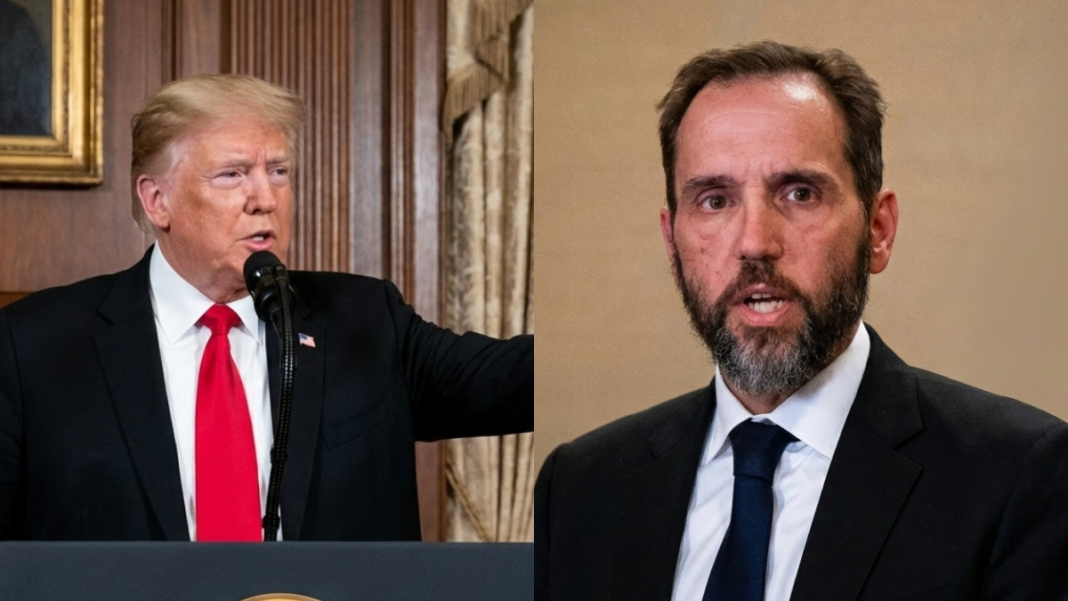

Former Special Counsel Jack Smith appeared before the House Judiciary Committee and defended his handling of two major federal cases involving former US President Donald Trump. The hearing marked Smith’s first detailed public testimony since leaving office and sparked strong reactions across party lines.
Smith said both cases were based entirely on evidence and the law, not politics. He rejected claims that the investigations were driven by personal bias or partisan motives and stated he would have pursued the same cases regardless of which political party was involved.
The two cases were later dropped after Trump returned to office in November 2024, following a long-standing Department of Justice rule that a sitting president cannot be prosecuted. Elizabeth Melimopoulos and News Agencies reported the hearing.
Smith Explains The Two Federal Cases
Smith was appointed in November 2022 to oversee two investigations involving Trump. One focused on classified documents, and the other examined efforts to overturn the 2020 election.
In the classified documents case, prosecutors accused Trump of keeping highly sensitive government records after leaving the White House in 2021. These documents were allegedly stored at his private residence in Florida. The charges included multiple counts under the Espionage Act for the willful retention of national defense information, along with accusations of obstructing justice and making false statements to investigators.
The second case focused on Trump’s actions following his loss in the 2020 presidential election. Prosecutors said he attempted to block the lawful transfer of power. The investigation examined events leading up to the January 6, 2021, attack on the US Capitol.
Trump was charged with conspiracy to defraud the United States and conspiracy against the rights of voters. Prosecutors did not accuse him of directly ordering the Capitol attack. Instead, they focused on his actions in the weeks before, including pressuring officials, spreading false claims of election fraud, and interfering with the certification process.
Both cases were closed after Trump was re-elected, in line with Justice Department policy.
Key Moments from the Hearing
During the hearing, Smith emphasized that no one should be above the law. He said the evidence showed criminal activity beyond a reasonable doubt and that accountability is essential for a functioning democracy.
Lawmakers questioned Smith about witness testimony, including statements made by former White House aide Cassidy Hutchinson. Hutchinson had claimed Trump tried to grab the steering wheel of his vehicle to go to the Capitol on January 6. Smith said her account was second-hand and could not be confirmed by investigators.
Donald Trump and Gavin Newsom clash in Switzerland as California fraud probe claims draw focus
He explained that the investigation relied on many witnesses and that building a strong case required selecting the most reliable evidence. Smith added that some of the most important witnesses were people who supported Trump and wanted him to win the election.
Republican lawmakers, including Representative Jim Jordan, challenged Smith’s methods. They questioned his use of phone records from members of Congress and the use of nondisclosure orders. Smith responded that these were standard investigative tools used to understand the scope of the alleged conspiracy and to protect witnesses from intimidation.
He denied spying on anyone and said nondisclosure orders were necessary due to concerns about threats and obstruction.
Public Safety, Democracy, and Political Reactions
Smith warned that failing to hold powerful individuals accountable could weaken democracy. He said when leaders are not held to the same legal standards as others, it sends a dangerous message that laws do not apply equally.
He explained that such a message could damage trust in elections, endanger election workers, and weaken the rule of law.
Smith also criticized Trump’s decision to issue mass pardons to people convicted in connection with the January 6 attack. On Trump’s first day back in office, he granted clemency to all those charged in the riot, including many convicted of assaulting police officers.
Smith said he did not understand why people who attacked law enforcement officers were pardoned. He described them as dangerous and said some had already committed new crimes after their release. He stated that pardoning such actions sends the wrong message about violence and public safety.
Trump responded to the testimony through social media, praising lawmakers who criticized Smith and attacking him personally. He described the investigations as politically motivated and accused those involved, including Jim Jordan, Brandon Gill, Kevin McCarthy, Letitia James, and James Comey, of wrongdoing.
The hearing highlighted deep political divisions. Supporters of Smith viewed the testimony as a defense of the rule of law, while critics saw it as proof of government overreach.
EU prepares €93bn trade retaliation as Trump escalates Greenland standoff
Throughout the hearing, Smith maintained that his actions were guided by evidence, legal standards, and concern for the country’s democratic institutions. He said the cases were built carefully using testimony from a wide range of witnesses.
Although the legal status of the cases remains unchanged, the hearing provided the public with a detailed account of how the investigations were conducted and why prosecutors believed the charges were justified.