

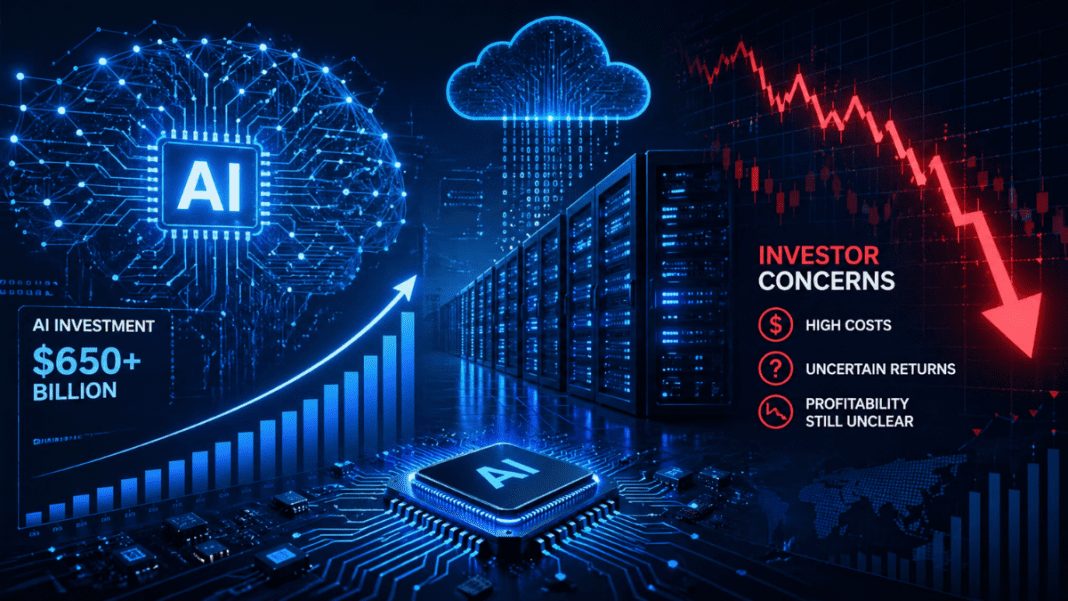

Artificial intelligence (AI) is becoming the biggest focus for major technology companies. Firms like Meta, Alphabet, Microsoft, and Amazon are spending huge amounts of money to build powerful AI systems. These include advanced data centers, custom computer chips, and next-generation AI tools.
Together, these companies are expected to spend more than $650 billion on AI in a single year. This level of investment is rarely seen in the technology sector.
However, this rapid spending has started to worry investors. Many are questioning whether such large investments will bring real returns anytime soon. The main concern is simple: companies are spending heavily now, but the profits from AI are still not fully clear.
Technology analyst Lee Sustar highlighted that there is growing anxiety about whether the AI boom can be sustained. The costs are very high, and the financial gains are still developing.
This situation has created a gap between what companies believe and what investors expect. While companies see AI as the future, investors want clearer proof that these investments are already working.
Meta’s Expanding AI Push Raises Questions
Meta has become a key example of this growing tension. The company has announced plans to increase its AI spending even further, raising its total planned investment to as much as $145 billion.
Meta to cut 10 percent of workforce while Microsoft offers voluntary buyouts in the US
This increase came after the company realized it had underestimated how much computing power would be needed. Its chief financial officer, Susan Li, explained that more spending is required to meet these demands.
At the same time, the company is building large-scale AI research efforts, including advanced labs aimed at becoming leaders in AI development.
Despite this ambition, investors are concerned about the lack of clear answers on how these investments will generate income. The company’s chief executive, Mark Zuckerberg, acknowledged that there is no precise plan yet for how each AI product will scale or turn into a business.
The company also shared how AI is already changing the way work is done internally. Smaller teams are now able to complete tasks much faster than before. This shift is raising questions about the future workforce and how many employees will be needed.
Susan Li noted that the company is still trying to understand what the ideal size of its workforce should be as AI continues to evolve.
Other Tech Firms Show Early AI Results
While concerns remain around AI spending, some companies are beginning to show early results from their investments.
Alphabet, the parent company of Google, reported strong growth linked to AI. Its profits increased by 30%, and its cloud business grew by 63%. This growth was largely driven by businesses using AI services through cloud platforms.
China stops Meta’s Manus acquisition over concerns about AI expertise transfer
The company’s chief executive, Sundar Pichai, pointed out that owning key technologies like AI models and computer chips helps the company stay competitive. Alphabet also plans to continue increasing its AI investments, with spending expected to reach $185 billion this year.
Microsoft also reported steady progress in its AI business. Its revenue rose by 16%, and profits increased by 23%. However, its large AI investments have reduced its free cash flow.
The company’s chief executive, Satya Nadella, said that its AI business has reached an annual run rate of $37 billion. This figure reflects expected future earnings based on current performance.
Amy Hood added that the company’s AI margins remain strong, even better than during its earlier shift to cloud computing.
Amazon also reported growth driven by AI. Its cloud business grew by 28%, and the company continues to expand its AI capabilities. It is also developing its own AI chips, which have reached an annual run rate of $20 billion.
The company’s chief executive, Andy Jassy, highlighted that AI is driving strong demand across its services. Amazon is also working with major AI providers and continues to invest heavily in the technology.
At the same time, the company confirmed that it has reduced its workforce by more than 30,000 employees in recent months, reflecting broader changes linked to AI adoption across the industry.