

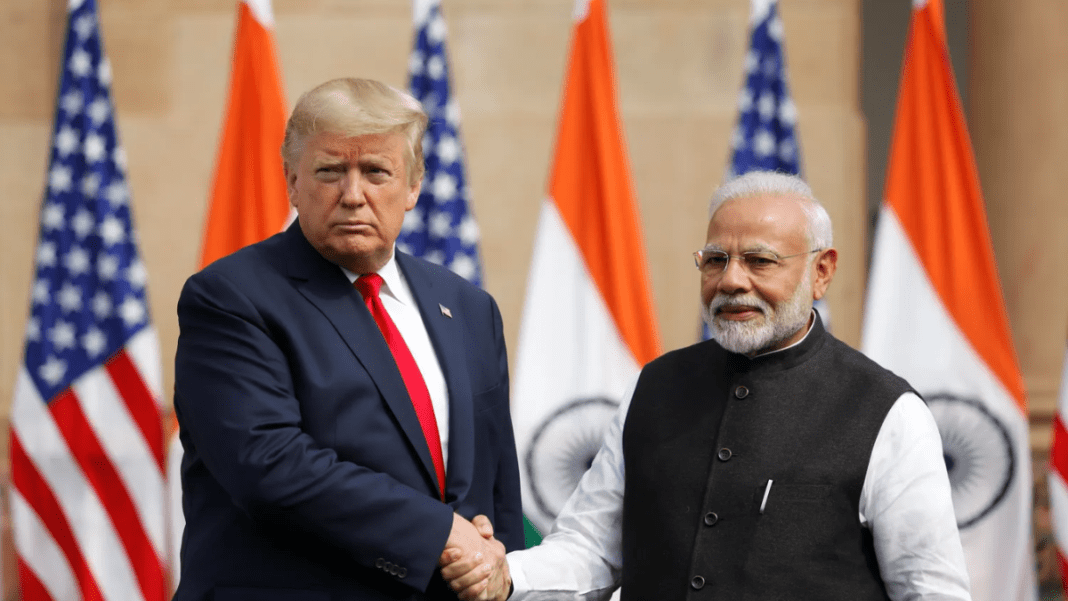
Reports say Trump tried to reach Modi four times but White House disputes claim

A Battle Over Tariffs and Oil

The relationship between the United States and India recently faced turbulence after reports revealed that President Donald Trump attempted several times to reach Indian Prime Minister Narendra Modi, but his calls went unanswered.

According to European and Asian media outlets, Trump tried four times to connect with Modi. These calls followed Washington’s decision to impose a steep 50 percent tariff on Indian imports. The measures included a 25 percent punitive tariff in response to India’s ongoing purchase of Russian oil, which Trump argued indirectly funds the war in Ukraine.

Sources suggested that Modi refused to take Trump’s calls, keeping his distance during the trade standoff. Reports highlighted Trump’s growing frustration as the missed calls became symbolic of the strained ties. The New York Times also confirmed that Trump’s calls were ignored, though White House spokesperson Anna Kelly publicly denied he had ever reached out.

Even while this was happening, the White House continued to emphasize that the two countries shared “a respectful relationship” and insisted that both leaders remained in communication. But behind the public statements, the disputes over tariffs and Russian oil painted a different picture.

Angry Posts and Harsh Words

President Donald Trump expressed his anger openly on September 1 through his social media platform, Truth Social. He wrote that India enjoyed massive trade benefits while American businesses suffered. According to Trump, India had imposed the highest tariffs of any country, making it difficult for American companies to enter the Indian market. He also voiced displeasure over India’s decision to buy most of its oil and defense equipment from Russia instead of the U.S.

McGregor channels Trump populism with Musk support in high-stakes Irish presidential race

In one post, Trump labeled the trade situation as “a one-sided disaster.” He also pointed to global shifts, sharing a photo of Prime Minister Narendra Modi with Russian President Vladimir Putin and Chinese President Xi Jinping at the Shanghai Cooperation Organization summit. The image showed Modi and Putin holding hands, which Trump used to argue that India was aligning more closely with Russia and China.

When questioned by reporters about his remark on “losing India,” Trump softened his stance. He said that the United States and India had a “special relationship” and stressed that he personally got along well with Modi, citing their meeting at the White House Rose Garden a few months earlier.

Warming Up With Sweet Words

Just days after his criticism, Donald Trump struck a completely different tone. In a fresh Truth Social post, he described Narendra Modi as a “very good friend.” He announced that talks were underway to reduce trade barriers and expressed confidence that both nations would find common ground.

Prime Minister Narendra Modi responded warmly on X, calling the United States a “close friend and natural partner.” He said he was confident that trade negotiations would unlock “limitless potential” for the India-U.S. partnership. Modi added that he looked forward to speaking directly with Trump soon.

Newsom draws Megyn Kelly’s ire after sharing old Trump clips to boost online trolling campaign

Despite the friendly tone, Trump kept pressing his criticism of India’s Russian oil imports. He said he was “very disappointed” that India continued to buy large amounts of oil from Moscow. He even called on the European Union to impose tariffs of up to 100 percent on goods from India and China to pressure Russia. According to reports, the move was designed to push Moscow into ending its war in Ukraine.

The back-and-forth exchanges between Donald Trump and Narendra Modi—from unanswered phone calls and tariff fights to sudden praise and warm messages—highlighted how complex the relationship had become.


Renuka Bangale
Renuka Bangale
Renuka is a distinguished Chartered Accountant and a Certified Digital Threats Analyst from Riskpro, renowned for her expertise in cybersecurity. With a deep understanding of cybercrimes, malware, cyber warfare, and espionage, she has established herself as an authority in the field. Renuka combines her financial acumen with advanced knowledge of digital threats to provide unparalleled insights into the evolving landscape of information security. Her analytical prowess enables her to dissect complex cyber incidents, offering clarity on risks and mitigation strategies. As a key contributor to Newsinterpretation’s information security category, Renuka delivers authoritative articles that educate and inform readers about emerging threats and best practices.

TOP 10 TRENDING ON NEWSINTERPRETATION

Cyber Attacks on Space Infrastructure: Satellites, GPS and the Ground Systems Behind Them

From the Viasat KA-SAT hack to GPS jamming over the Baltic, a research guide to how attackers target satellites, navigation signals and ground stations, and why it matters on Earth.

How AI Agents Are Used in Cyber Attacks: From Assisted Hacking to AI-Orchestrated Espionage

Attackers now use AI agents to scan networks, write exploits and run extortion campaigns. A research guide to documented cases, including the first reported AI-orchestrated espionage campaign, and what defenders should do.

Cyber Attacks on AI and LLMs: How Attackers Target Large Language Models

Prompt injection, data poisoning, model theft and jailbreaks: a research guide to how attackers target AI systems and large language models, with real cases and defences.

French Supermarket Refrigeration Cyberattack: How Hacking the Cold Chain Can Endanger Lives

In October 2026 attackers heated refrigeration cabinets in hundreds of French supermarkets to as much as 50°C. No one was hurt, but the attack shows how hacking the cold chain can endanger lives through fire, food poisoning and spoiled medicines.

Cyberattacks on Nuclear Facilities: Stuxnet, Kudankulam and the Limits of Air Gaps

Stuxnet, the Davis-Besse worm and malware at India’s Kudankulam plant: what they show about cyber risk at nuclear facilities and the limits of air gaps.

Triton: When Hackers Target the Safety Systems That Prevent Industrial Disasters

The 2017 Triton attack targeted the safety systems that prevent industrial disasters. What happened, who was charged, and how plants protect their last line of defence.

Cybersecurity Risks in Smart Cities: When Connected Infrastructure Fails

How connecting traffic control, emergency alerts and utilities concentrates cyber risk in cities, what the Dallas and Atlanta incidents showed, and what governments recommend.

Weaponized Drones: Hijacking, GPS Spoofing and Emerging Cyber Warfare Risks

How drones can be hijacked, jammed or misled by GPS spoofing, what researchers have demonstrated, and why governments treat drone fleets as a security risk.

Ransomware Attacks on Hospitals: How Healthcare Cyberattacks Put Patients at Risk

How ransomware against hospitals and their suppliers delays care and endangers patients, what the Düsseldorf and WannaCry cases show, and what research says about deaths.

Operational blunder exposes massive Russian cyber espionage attack on Ukrainian prosecutors

A major cyberattack has compromised the email accounts of...

Cyber Attacks on Space Infrastructure: Satellites, GPS and the Ground Systems Behind Them

From the Viasat KA-SAT hack to GPS jamming over the Baltic, a research guide to how attackers target satellites, navigation signals and ground stations, and why it matters on Earth.

French Supermarket Refrigeration Cyberattack: How Hacking the Cold Chain Can Endanger Lives

In October 2026 attackers heated refrigeration cabinets in hundreds of French supermarkets to as much as 50°C. No one was hurt, but the attack shows how hacking the cold chain can endanger lives through fire, food poisoning and spoiled medicines.

Cyberattacks on Nuclear Facilities: Stuxnet, Kudankulam and the Limits of Air Gaps

Stuxnet, the Davis-Besse worm and malware at India’s Kudankulam plant: what they show about cyber risk at nuclear facilities and the limits of air gaps.

Triton: When Hackers Target the Safety Systems That Prevent Industrial Disasters

The 2017 Triton attack targeted the safety systems that prevent industrial disasters. What happened, who was charged, and how plants protect their last line of defence.

Cybersecurity Risks in Smart Cities: When Connected Infrastructure Fails

How connecting traffic control, emergency alerts and utilities concentrates cyber risk in cities, what the Dallas and Atlanta incidents showed, and what governments recommend.

Ransomware Attacks on Hospitals: How Healthcare Cyberattacks Put Patients at Risk

How ransomware against hospitals and their suppliers delays care and endangers patients, what the Düsseldorf and WannaCry cases show, and what research says about deaths.

FBI warns of AVrecon malware targeting outdated routers linked to proxy based cybercrime

A serious cybersecurity warning has been issued regarding commonly...

Related Articles

Popular Categories
