

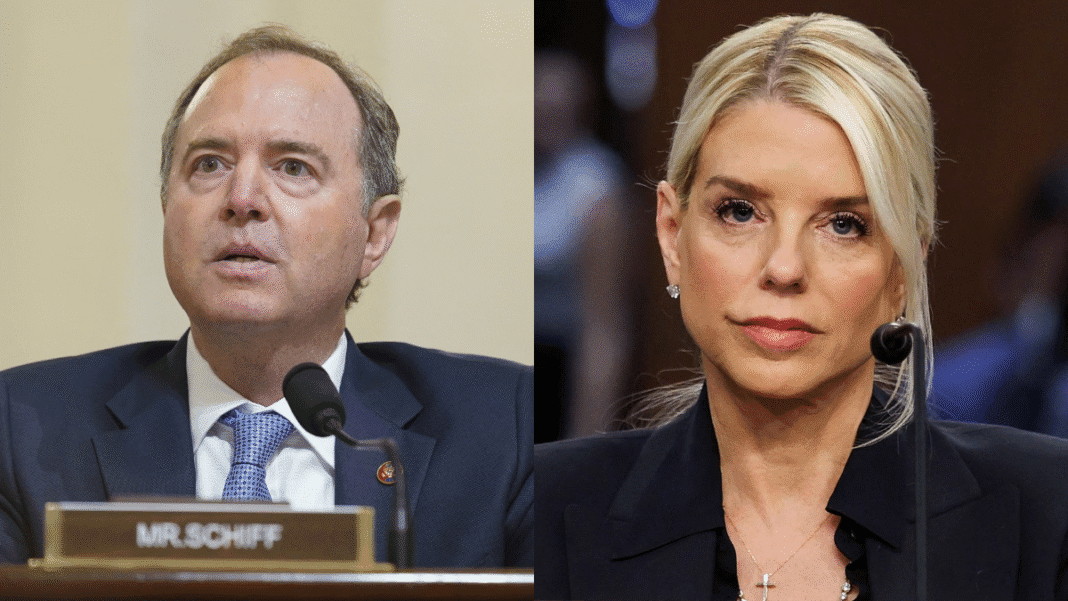
Senate hearing explodes into chaos as Bondi dodges ethics questions and attacks Schiff

A heated Senate hearing took a dramatic turn when Senator Adam Schiff publicly listed all the questions that Attorney General Pam Bondi refused to answer. The session quickly became chaotic as Bondi clashed with Schiff, avoiding crucial topics while launching personal attacks.

The hearing was meant to review important decisions by the Department of Justice (DOJ) under President Donald Trump. Instead, it turned into a confrontation over unanswered questions, ethical concerns, and accountability in government. Lawmakers repeatedly asked for transparency, but Bondi’s evasions dominated the discussion.

A Growing List of Ignored Questions

During the hearing, Senator Schiff carefully tracked the questions Bondi ignored or deflected. Some of the most notable questions involved financial decisions, government ethics, and high-profile investigations.

For example, Schiff asked whether career ethics lawyers were consulted when approving President Trump’s acceptance of a $400 million jet gifted by Qatar. Questions also focused on whether President Trump’s name was flagged in the FBI’s review of the Epstein files and whether Tom Homan, now Trump’s border czar, kept $50,000 from undercover FBI agents and paid taxes on it.

From campaign cash to foreign lobbying: Pam Bondi’s past resurfaces in Epstein storm

Other questions concerned whether prosecutors determined there was insufficient evidence to charge FBI Director James Comey before he was indicted, and whether Bondi approved the dismissal of antitrust lawyers opposing the Hewlett Packard–Juniper merger. Schiff also asked if Bondi supported a compensation fund for people prosecuted in connection with the January 6, 2021, Capitol riots and whether she was firing career prosecutors working on those investigations.

Schiff emphasized that all these questions were part of the hearing’s oversight purpose. Each time, instead of providing answers, Bondi either changed the topic, launched personal attacks, or refused to respond. Schiff insisted it was crucial for the public to know which questions were being ignored and why accountability was being avoided.

Personal Attacks and Deflection

At several points, Bondi interrupted Schiff. She questioned his credentials and brought up unrelated issues, including wildfires and riots in his home state, as a way to avoid answering. She repeatedly called Schiff a “failed lawyer” and accused him of slandering President Trump.

Despite these attacks, Schiff stayed focused on the purpose of the hearing. He reminded the committee that the session was meant to hold the DOJ accountable for actions under President Trump. The aim was to get clear answers on government decisions, financial ethics, and the proper handling of legal investigations.

He emphasized that the American people deserve to know the truth when top officials avoid questions about serious matters. Schiff urged other lawmakers to demand answers and not accept personal attacks as substitutes for honest responses.

Senator Tammy Duckworth slams defense secretary Pete Hegseth for ‘deeply unfair’ remarks on women in combat

Key Issues Highlighted

The questions left unanswered touched on a wide range of serious topics. They included whether officials properly reported large sums of money, whether career prosecutors were punished for doing their jobs, and whether legal rules were followed in major investigations.

Some questions also focused on decisions about U.S. military actions and whether they were legally justified. Others questioned whether compensation or justice was properly provided in high-profile cases, and whether government officials followed court orders.

Throughout the session, the tension was clear. Schiff repeatedly stressed that oversight hearings are meant to uncover facts and hold the DOJ accountable, not allow personal slander to replace answers. He noted that dozens of career prosecutors had already been fired for working on sensitive investigations, highlighting the importance of transparency in government.

The hearing concluded with a long list of unanswered questions, showing a clear conflict between congressional oversight and Bondi’s evasions. Lawmakers left the session with detailed notes on what was avoided, creating a record of refusal to answer key questions on ethics, finance, and legal procedures under President Trump.


T U Deshmukh
T U Deshmukh
T U Deshmukh is the leading voice on the subject of Jobs, AI, Data and layoffs and she regularly contributes a column on Jobs for Newsinterpretation.

TOP 10 TRENDING ON NEWSINTERPRETATION

Cyber Attacks on Space Infrastructure: Satellites, GPS and the Ground Systems Behind Them

From the Viasat KA-SAT hack to GPS jamming over the Baltic, a research guide to how attackers target satellites, navigation signals and ground stations, and why it matters on Earth.

How AI Agents Are Used in Cyber Attacks: From Assisted Hacking to AI-Orchestrated Espionage

Attackers now use AI agents to scan networks, write exploits and run extortion campaigns. A research guide to documented cases, including the first reported AI-orchestrated espionage campaign, and what defenders should do.

Cyber Attacks on AI and LLMs: How Attackers Target Large Language Models

Prompt injection, data poisoning, model theft and jailbreaks: a research guide to how attackers target AI systems and large language models, with real cases and defences.

French Supermarket Refrigeration Cyberattack: How Hacking the Cold Chain Can Endanger Lives

In October 2026 attackers heated refrigeration cabinets in hundreds of French supermarkets to as much as 50°C. No one was hurt, but the attack shows how hacking the cold chain can endanger lives through fire, food poisoning and spoiled medicines.

Cyberattacks on Nuclear Facilities: Stuxnet, Kudankulam and the Limits of Air Gaps

Stuxnet, the Davis-Besse worm and malware at India’s Kudankulam plant: what they show about cyber risk at nuclear facilities and the limits of air gaps.

Triton: When Hackers Target the Safety Systems That Prevent Industrial Disasters

The 2017 Triton attack targeted the safety systems that prevent industrial disasters. What happened, who was charged, and how plants protect their last line of defence.

Cybersecurity Risks in Smart Cities: When Connected Infrastructure Fails

How connecting traffic control, emergency alerts and utilities concentrates cyber risk in cities, what the Dallas and Atlanta incidents showed, and what governments recommend.

Weaponized Drones: Hijacking, GPS Spoofing and Emerging Cyber Warfare Risks

How drones can be hijacked, jammed or misled by GPS spoofing, what researchers have demonstrated, and why governments treat drone fleets as a security risk.

Ransomware Attacks on Hospitals: How Healthcare Cyberattacks Put Patients at Risk

How ransomware against hospitals and their suppliers delays care and endangers patients, what the Düsseldorf and WannaCry cases show, and what research says about deaths.

Operational blunder exposes massive Russian cyber espionage attack on Ukrainian prosecutors

A major cyberattack has compromised the email accounts of...

Cyber Attacks on Space Infrastructure: Satellites, GPS and the Ground Systems Behind Them

From the Viasat KA-SAT hack to GPS jamming over the Baltic, a research guide to how attackers target satellites, navigation signals and ground stations, and why it matters on Earth.

French Supermarket Refrigeration Cyberattack: How Hacking the Cold Chain Can Endanger Lives

In October 2026 attackers heated refrigeration cabinets in hundreds of French supermarkets to as much as 50°C. No one was hurt, but the attack shows how hacking the cold chain can endanger lives through fire, food poisoning and spoiled medicines.

Cyberattacks on Nuclear Facilities: Stuxnet, Kudankulam and the Limits of Air Gaps

Stuxnet, the Davis-Besse worm and malware at India’s Kudankulam plant: what they show about cyber risk at nuclear facilities and the limits of air gaps.

Triton: When Hackers Target the Safety Systems That Prevent Industrial Disasters

The 2017 Triton attack targeted the safety systems that prevent industrial disasters. What happened, who was charged, and how plants protect their last line of defence.

Cybersecurity Risks in Smart Cities: When Connected Infrastructure Fails

How connecting traffic control, emergency alerts and utilities concentrates cyber risk in cities, what the Dallas and Atlanta incidents showed, and what governments recommend.

Ransomware Attacks on Hospitals: How Healthcare Cyberattacks Put Patients at Risk

How ransomware against hospitals and their suppliers delays care and endangers patients, what the Düsseldorf and WannaCry cases show, and what research says about deaths.

FBI warns of AVrecon malware targeting outdated routers linked to proxy based cybercrime

A serious cybersecurity warning has been issued regarding commonly...

Related Articles

Popular Categories
