

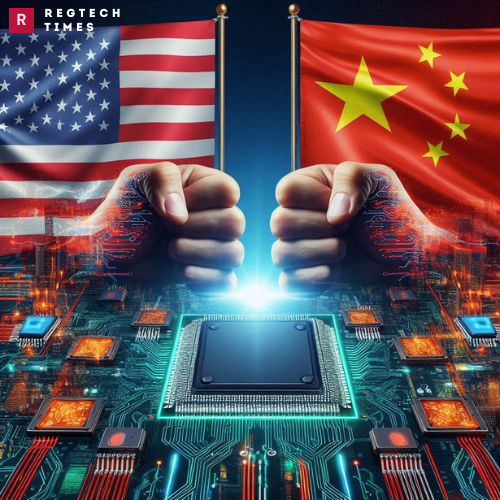

In the escalating tech war between the United States and China, semiconductors have emerged as a crucial battleground. The Biden administration, keen to curb China’s advancements in artificial intelligence (AI) hardware, is now seeking the assistance of key allies—Japan and the Netherlands. These efforts are centered around restricting China’s access to high-bandwidth memory (HBM) chips, essential components for AI development.
The Strategic Importance of HBM Chips
HBM chips, known for their high-speed data transfer capabilities, are vital for AI accelerators produced by companies like Nvidia and Advanced Micro Devices (AMD). These chips significantly enhance the performance of AI systems by speeding up memory access. As AI becomes increasingly integral to global technological leadership, controlling the production and distribution of HBM chips is seen as a strategic imperative in the tech war.
The CHIPS Act of 2022: Revitalizing the U.S. Semiconductor Industry Defying Global Competition
US Efforts to Tighten Controls
For years, the US has implemented a range of export controls to restrict China’s capability to acquire and manufacture advanced semiconductors. Despite these efforts, Chinese companies, notably Huawei and Yangtze Memory Technologies Corp (YMTC), have made significant strides. Huawei, for instance, is developing its own AI accelerators, known as Ascend, which can potentially bypass some of the existing restrictions.
The US Under Secretary of Commerce for Industry and Security, Alan Estevez, is spearheading a new diplomatic push to secure tighter restrictions. Estevez’s upcoming visits to Japan and the Netherlands aim to persuade these countries to impose stricter limits on their semiconductor equipment companies’ operations in China.
US Restrictions on AI Chips is Innovative Mechanism of Sanctions on China
Key Players: ASML and Tokyo Electron in the Tech War
ASML Holding in the Netherlands and Tokyo Electron in Japan are pivotal to the global semiconductor supply chain. Their machinery is essential for producing dynamic random access memory (DRAM) dies, which are stacked to create HBM chips. By restricting the activities of these companies in China, the US hopes to stymie Chinese advancements in semiconductor technology in this tech war.
China Skirts US Sanctions; Oracle is Powering Tiktok with Nvidia AI Chips
However, Japan and the Netherlands have so far resisted US pressure for more stringent measures. Both countries have implemented some export controls but are cautious about expanding them further without thoroughly evaluating their impact and considering the political landscape, particularly the upcoming US presidential election.
Political Dynamics in the Netherlands
The political situation in the Netherlands adds another layer of complexity to the tech war. With a new government expected to be sworn in soon, it remains uncertain how the Dutch will respond to US demands. Reinette Klever of the far-right Freedom Party, known for her contentious views, is set to become the minister for foreign trade and development aid, a role that includes overseeing export control policies.
The outgoing Dutch Foreign Trade Minister, Liesje Schreinemacher, recently visited the US to advocate for ASML’s interests, highlighting the economic significance of the semiconductor industry to the Netherlands.
Amsterdam Dismantles Chinese Surveillance Cameras to Combat Espionage Challenge
Global Semiconductor Supply Chain
The global nature of the semiconductor supply chain means that any restrictions imposed by the US, Japan, and the Netherlands will have far-reaching implications in the tech war. South Korean companies like SK Hynix and Samsung Electronics, leaders in HBM chip production, also rely on equipment from ASML and Tokyo Electron. Earlier this year, Washington requested Seoul to limit the flow of high-end chip-making technologies to China, reflecting the broader strategy to constrain Chinese technological capabilities.
Leticia Zheng Exposed in Sinister 7-Year Chinese Espionage Operation at the University of Florida
Chinese Advances and US Legislative Actions in the Tech War
Despite existing restrictions, China continues to advance in semiconductor technologies, fueling the tech war. Companies like Wuhan Xinxin Semiconductor Manufacturing Co. and ChangXin Memory Technologies are actively developing HBM chips. This progress highlights the need for the US to seek broader international cooperation to effectively limit China’s semiconductor ambitions.
Export Scheme: 2 Chinese Nationals Accused in Illegal Semiconductor Plot
In a bid to further tighten controls in this tech war, US lawmakers have introduced a bipartisan bill aimed at preventing companies that receive US funding for semiconductor factories from purchasing Chinese tools. This legislation represents another layer of the comprehensive strategy to isolate China’s semiconductor sector.
The tech war between the US and China over semiconductors is a high-stakes conflict with significant implications for global technological leadership. The US’s efforts to rally allies like Japan and the Netherlands highlight the critical importance of international collaboration in this endeavor. As the geopolitical landscape evolves, the effectiveness of these strategies will be closely watched, determining the balance of power in the rapidly advancing field of AI technology.