

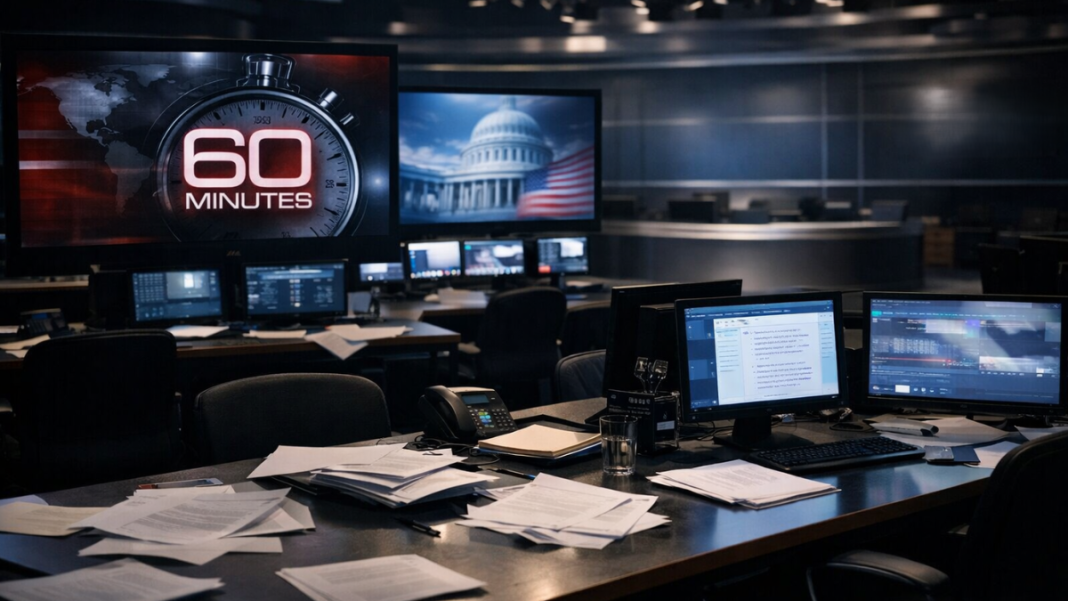
CBS News erupts after last-minute decision halts cleared 60 Minutes investigation

A serious internal conflict has erupted inside CBS News after a last-minute decision halted a prepared 60 Minutes investigative report, leading to sharp criticism from newsroom staff and senior journalists. The dispute centers on editorial control, newsroom trust, and concerns over political pressure, all unfolding within a tight and clearly defined timeline.

The controversy became public after details of a tense internal meeting leaked, revealing deep frustration among staff members who believed the report was ready for broadcast and improperly stopped.

A Cleared Investigation Halted Hours Before Airing

The halted report focused on conditions inside a large prison in El Salvador, where Venezuelan men deported during the Donald Trump administration were being held. The segment described severe overcrowding and harsh conditions inside the facility.

According to newsroom sources, the report followed standard editorial procedures. It was screened five times and approved by CBS attorneys and the Standards and Practices department. It was scheduled to air on Sunday.

However, on Saturday, Bari Weiss, the editor-in-chief of CBS News, raised concerns and asked for additional reporting. These concerns were shared with Tanya Simon, the executive producer of 60 Minutes, and included a request for an interview with someone from the Trump administration.

GAO report backs AOC’s warning on Puerto Rico tax breaks costing taxpayers hundreds of millions

Simon later told staff that she defended the segment but ultimately had to comply with Weiss’s demands. Because the concerns were raised so late, the production team said they could not gather new material in time, leading to the story being shelved.

Weiss had reportedly viewed the segment for the first time the previous Thursday and initially approved it, making the timing of her objections a key point of contention.

Staff Backlash and Claims of Political Motivation

The decision triggered strong reactions inside the newsroom. During a Monday staff meeting, Scott Pelley, a longtime correspondent, criticized Weiss’s involvement, stating that leadership of the newsroom is “not a part-time job,” according to Michael M. Grynbaum of The New York Times.

Simon told colleagues she stood fully behind the report and its correspondent, Sharyn Alfonsi. Alfonsi later sent a memo to staff describing the shelving of the report as a political decision. She said Weiss did not contact her directly to discuss the concerns.

Alfonsi explained that requests for comment had already been sent to the Department of Homeland Security, the White House, and the State Department, but no responses were received. She warned that if stories can be stopped because officials decline to comment, it could allow those in power to block coverage they dislike.

Redacted Epstein files trigger backlash as AOC names DOJ and demands accountability

At a separate editorial call, Weiss urged staff to handle disagreements with respect. Alfonsi responded during the meeting that disagreement requires direct discussion, not silence.

Political Timing and Leadership Pressure

The timing of the decision intensified concerns. Weiss raised her objections only hours after Donald Trump publicly criticized CBS and 60 Minutes during a rally in North Carolina. Trump accused the program of unfair treatment and praised CBS’s new ownership.

CBS News leadership changed following an $8 billion merger between Paramount and Skydance Media, approved by the Federal Communications Commission. David Ellison, Skydance’s CEO, appointed Weiss as editor-in-chief in October.

Sources inside CBS News believe the editorial decision may have been influenced by mounting political pressure. Weiss has denied this, stating that her role is to ensure stories meet high standards and that holding stories due to missing context or voices is common practice.

In a statement to The New York Times, Weiss said she looks forward to airing the segment once it is ready. Despite this, the report remains unaired, and tensions inside CBS News continue following what many staff members describe as a deeply damaging internal dispute.

T U Deshmukh
T U Deshmukh
T U Deshmukh is the leading voice on the subject of Jobs, AI, Data and layoffs and she regularly contributes a column on Jobs for Newsinterpretation.

TOP 10 TRENDING ON NEWSINTERPRETATION

Cyber Attacks on Space Infrastructure: Satellites, GPS and the Ground Systems Behind Them

From the Viasat KA-SAT hack to GPS jamming over the Baltic, a research guide to how attackers target satellites, navigation signals and ground stations, and why it matters on Earth.

How AI Agents Are Used in Cyber Attacks: From Assisted Hacking to AI-Orchestrated Espionage

Attackers now use AI agents to scan networks, write exploits and run extortion campaigns. A research guide to documented cases, including the first reported AI-orchestrated espionage campaign, and what defenders should do.

Cyber Attacks on AI and LLMs: How Attackers Target Large Language Models

Prompt injection, data poisoning, model theft and jailbreaks: a research guide to how attackers target AI systems and large language models, with real cases and defences.

French Supermarket Refrigeration Cyberattack: How Hacking the Cold Chain Can Endanger Lives

In October 2026 attackers heated refrigeration cabinets in hundreds of French supermarkets to as much as 50°C. No one was hurt, but the attack shows how hacking the cold chain can endanger lives through fire, food poisoning and spoiled medicines.

Cyberattacks on Nuclear Facilities: Stuxnet, Kudankulam and the Limits of Air Gaps

Stuxnet, the Davis-Besse worm and malware at India’s Kudankulam plant: what they show about cyber risk at nuclear facilities and the limits of air gaps.

Triton: When Hackers Target the Safety Systems That Prevent Industrial Disasters

The 2017 Triton attack targeted the safety systems that prevent industrial disasters. What happened, who was charged, and how plants protect their last line of defence.

Cybersecurity Risks in Smart Cities: When Connected Infrastructure Fails

How connecting traffic control, emergency alerts and utilities concentrates cyber risk in cities, what the Dallas and Atlanta incidents showed, and what governments recommend.

Weaponized Drones: Hijacking, GPS Spoofing and Emerging Cyber Warfare Risks

How drones can be hijacked, jammed or misled by GPS spoofing, what researchers have demonstrated, and why governments treat drone fleets as a security risk.

Ransomware Attacks on Hospitals: How Healthcare Cyberattacks Put Patients at Risk

How ransomware against hospitals and their suppliers delays care and endangers patients, what the Düsseldorf and WannaCry cases show, and what research says about deaths.

Operational blunder exposes massive Russian cyber espionage attack on Ukrainian prosecutors

A major cyberattack has compromised the email accounts of...

Cyber Attacks on Space Infrastructure: Satellites, GPS and the Ground Systems Behind Them

From the Viasat KA-SAT hack to GPS jamming over the Baltic, a research guide to how attackers target satellites, navigation signals and ground stations, and why it matters on Earth.

French Supermarket Refrigeration Cyberattack: How Hacking the Cold Chain Can Endanger Lives

In October 2026 attackers heated refrigeration cabinets in hundreds of French supermarkets to as much as 50°C. No one was hurt, but the attack shows how hacking the cold chain can endanger lives through fire, food poisoning and spoiled medicines.

Cyberattacks on Nuclear Facilities: Stuxnet, Kudankulam and the Limits of Air Gaps

Stuxnet, the Davis-Besse worm and malware at India’s Kudankulam plant: what they show about cyber risk at nuclear facilities and the limits of air gaps.

Triton: When Hackers Target the Safety Systems That Prevent Industrial Disasters

The 2017 Triton attack targeted the safety systems that prevent industrial disasters. What happened, who was charged, and how plants protect their last line of defence.

Cybersecurity Risks in Smart Cities: When Connected Infrastructure Fails

How connecting traffic control, emergency alerts and utilities concentrates cyber risk in cities, what the Dallas and Atlanta incidents showed, and what governments recommend.

Ransomware Attacks on Hospitals: How Healthcare Cyberattacks Put Patients at Risk

How ransomware against hospitals and their suppliers delays care and endangers patients, what the Düsseldorf and WannaCry cases show, and what research says about deaths.

FBI warns of AVrecon malware targeting outdated routers linked to proxy based cybercrime

A serious cybersecurity warning has been issued regarding commonly...

Related Articles

Popular Categories
