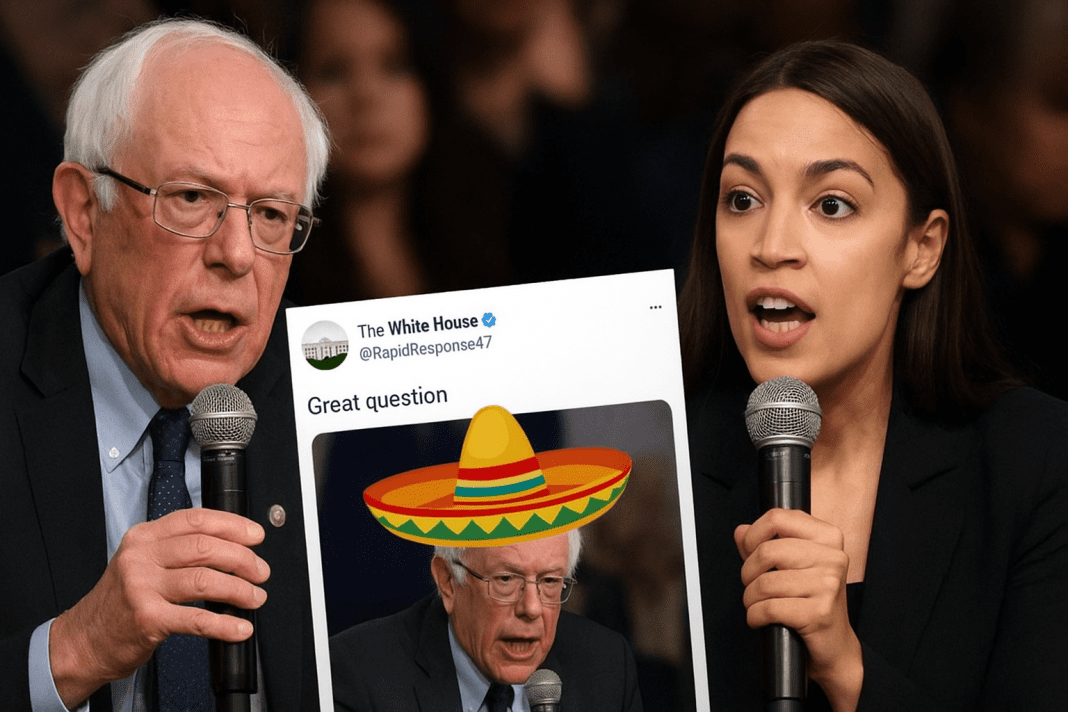

The White House erupted on social media as Democratic lawmakers Bernie Sanders and Alexandria Ocasio-Cortez faced questions about the ongoing government shutdown during a live town hall on Wednesday night. The event, which ran for 90 minutes, drew a live audience and saw lawmakers taking questions on a variety of issues, from tax breaks to immigration policies.
Rapid-Fire Social Media Reactions With Ocasio-Cortez
Throughout the session, the White House’s RapidResponse47 X account actively live-posted updates, responding in real time to statements made by Sanders and Ocasio-Cortez. Many posts were sharply critical, with the account labeling Sanders’ remarks as “crazy” and repeatedly mocking the messaging strategies of Democratic leaders, including Ocasio-Cortez.
During a question about social media influence, student Nicole Plewicka asked Sanders why Republican messaging seemed more effective than Democratic messaging. Sanders acknowledged that Republicans had learned to use social media more effectively, but he mistakenly said that Amazon boss Jeff Bezos owned X, confusing him with tech billionaire Elon Musk. This slip was immediately seized upon by right-leaning users online, with one calling him “Biden 2.0.”
AOC breaks silence with powerful words for transgender youth facing growing backlash
RapidResponse47 posted about the comment, claiming Sanders thought Republicans were more effective because “tech companies and the mainstream media are in the tank for us,” accompanied by laughing emojis. The account also shared clips of Sanders’ remarks, overlaying a sombrero on his head and adding Latin music, emphasizing a mocking tone.
Ocasio-Cortez was also highlighted in the live posts, with the account mocking her phrasing mistakes and emphasizing what it described as contradictory messaging from Democrats.
Clashes Over Policy and Leadership
Audience questions quickly moved to the government shutdown and political leadership. Student Rohan Naval asked Sanders how the shutdown reflected on Senate Minority Leader Chuck Schumer. Sanders responded by placing more responsibility on House Speaker Mike Johnson and former President Trump. When Naval disagreed, Sanders emphasized the consequences of tax breaks for the wealthy combined with cuts to healthcare for working-class Americans.
RapidResponse47 labeled this exchange as Sanders getting “wrecked on national television,” continuing its aggressive commentary. Other topics included ICE raids and federal enforcement actions, with Sanders describing these as attempts to intimidate and create fear. The social media account countered, calling him “absolutely deranged” for suggesting these actions were authoritarian.
How Bernie Sanders and AOC Are Winning Back Disillusioned Voters in a Bold Rebirth
Questions about ending the shutdown led Sanders to reiterate that Democrats were working to resolve the stalemate. He also warned of potential collapse in the health system if the political impasse continued, framing the discussion around the stakes for ordinary Americans. Ocasio-Cortez responded to similar questions by emphasizing the need for healthcare protections, which were also highlighted and mocked in the White House posts.
Mockery and Messaging Focused on Ocasio-Cortez
Ocasio-Cortez also faced scrutiny, with some posts highlighting a slip in her phrasing when she said “air that is drinkable.” The White House’s online commentary extended to playful criticism of both lawmakers, with posts suggesting that the Democratic messaging team, including Ocasio-Cortez, was disorganized. RapidResponse47 repeatedly emphasized that Sanders and Ocasio-Cortez’s statements were primarily focused on countering Trump and defending Democratic priorities.
In addition to mocking remarks, the White House reposted videos from the town hall, using visual edits and captions to amplify criticism. Comments repeatedly highlighted Sanders and Ocasio-Cortez’s statements about healthcare, tax policy, and immigration enforcement. Ocasio-Cortez was mentioned several times as an example of Democratic messaging errors.
AOC Turns Controversy Into Conversation — How Her ‘Short King’ Moment Became a Lesson in Empathy
The social media activity represented one of the most aggressive live-posting responses from the White House in recent months. By closely following every exchange, including comments made by Ocasio-Cortez, and publicly criticizing responses from the Democratic lawmakers, the account aimed to frame the discussion in a way favorable to the administration while drawing attention to what it described as contradictory or extreme statements.
This live social media reaction reflects how political communication has increasingly moved into real-time digital platforms. Through rapid posting, edited video clips, and humorous commentary, the White House leveraged the town hall event to directly address supporters and opponents alike, maintaining a continuous online narrative throughout the evening. Ocasio-Cortez’s remarks were among the key points highlighted throughout the night.