

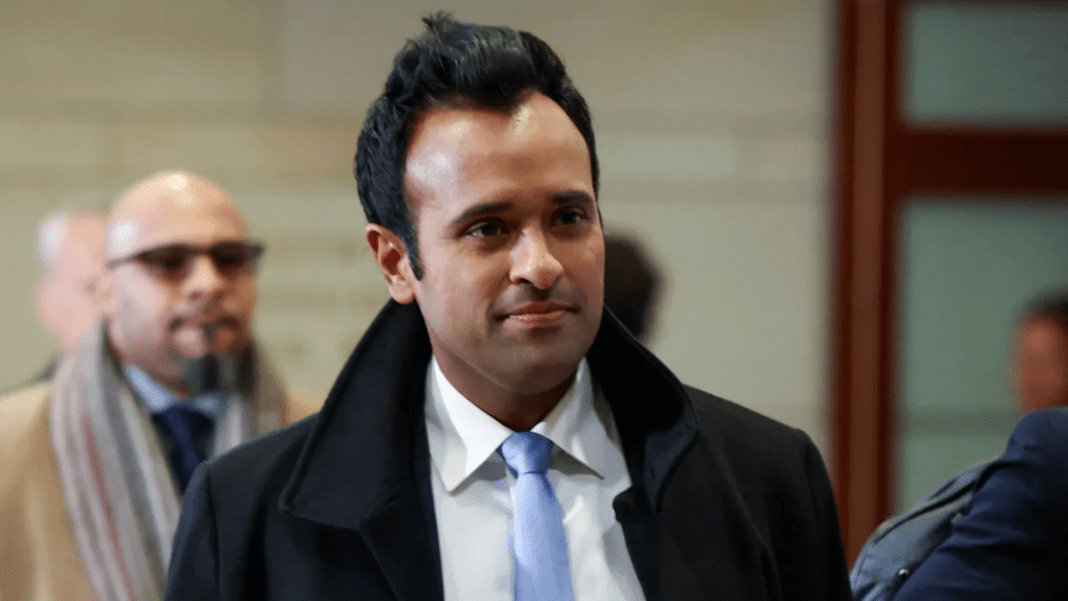
Vivek Ramaswamy caught deleting education proposal — MAGA influencers insist leaked clip is “AI,” but it matches his own upload

A political clash erupted after Ohio gubernatorial candidate Vivek Ramaswamy posted a video outlining ideas to lower costs for families. In the video, titled “Here’s how Republicans win in 2026,” he listed several suggestions. One of them was unexpected. Ramaswamy said schools should become year-round and stay open until 4 p.m. instead of 3 p.m. He explained that this change would make parenting more affordable by reducing the need for childcare.

The full video went live on Monday afternoon. It stayed up for several hours before Ramaswamy deleted it and replaced it with a new version. The updated version removed the year-round school proposal completely. However, the original video still remained visible on his Threads account. No official reason was given for editing it.

That night, the removed clip was posted on X by Dr. Amy Acton, the Democrat running against him in the 2026 Ohio governor race. Her post brought immediate attention, as social media users noticed the clip highlighted a proposal that Ramaswamy had chosen to remove from most of his platforms.

This could be 2008 all over again’: AOC warns Wall Street’s AI obsession may trigger catastrophic crash

MAGA Figures Claim the Clip Is AI

Once Acton’s post spread online, several MAGA voices argued the video was not real. They insisted it had been created using artificial intelligence. Jack Posobiec reacted by saying Acton had fallen for “AI videos.” Gabe Guidarini, chairman of the Ohio College Republican Federation, wrote that any candidate who shares what he called “AI-altered videos” should face major financial penalties. Nick Adams joined the discussion as well, simply declaring, “This is AI.”

Their claims caused a wave of confusion. Many users pushed back, noting that the clip matched the original footage Ramaswamy himself had uploaded earlier in the day. The only difference was that he later deleted that section from other platforms.

The debate grew louder when Acton’s campaign stepped in. Her campaign manager, Philip Stein, criticized the year-round school idea as damaging to school budgets and out of touch with Ohio families. He also remarked that “even his own supporters think his videos are AI,” referring to the MAGA reactions.

Trump defends Susie Wiles as MAGA base accuses her of sabotaging the ‘America First’ agenda

Ramaswamy did not respond to requests for comment at the time, leaving open questions about why he removed the proposal and why the edited version left out only that part.

Background and Political Reactions

Ramaswamy had never supported year-round school before this video. His campaign website focuses on children gaining strong skills in reading, writing, math, and critical thinking. In past statements, he supported raising academic standards, using AI in classrooms, expanding school choice, and helping kids improve literacy. The idea of extending the school year did not appear in any earlier proposals.

Ramaswamy is well known nationally. He ran for president in 2024 as a far-right, “anti-woke” candidate. After finishing fourth in the Iowa caucuses, he ended his campaign but stayed aligned with Donald Trump. When Trump entered office, he selected Ramaswamy to help lead DOGE, a government efficiency effort planned alongside Elon Musk. Ramaswamy stepped away from DOGE on Trump’s first day in office to focus on the Ohio governor’s race. Rumors suggested Musk pushed him out, but Ramaswamy denied those claims.

The resurfaced clip, its deletion, and the MAGA claims of AI quickly turned the proposal into a central topic of debate. The reaction showed how fast political messages can shift online and how quickly accusations of artificial intelligence can take over public discussion.


T U Deshmukh
T U Deshmukh
T U Deshmukh is the leading voice on the subject of Jobs, AI, Data and layoffs and she regularly contributes a column on Jobs for Newsinterpretation.

TOP 10 TRENDING ON NEWSINTERPRETATION

Cyber Attacks on Space Infrastructure: Satellites, GPS and the Ground Systems Behind Them

From the Viasat KA-SAT hack to GPS jamming over the Baltic, a research guide to how attackers target satellites, navigation signals and ground stations, and why it matters on Earth.

How AI Agents Are Used in Cyber Attacks: From Assisted Hacking to AI-Orchestrated Espionage

Attackers now use AI agents to scan networks, write exploits and run extortion campaigns. A research guide to documented cases, including the first reported AI-orchestrated espionage campaign, and what defenders should do.

Cyber Attacks on AI and LLMs: How Attackers Target Large Language Models

Prompt injection, data poisoning, model theft and jailbreaks: a research guide to how attackers target AI systems and large language models, with real cases and defences.

French Supermarket Refrigeration Cyberattack: How Hacking the Cold Chain Can Endanger Lives

In October 2026 attackers heated refrigeration cabinets in hundreds of French supermarkets to as much as 50°C. No one was hurt, but the attack shows how hacking the cold chain can endanger lives through fire, food poisoning and spoiled medicines.

Cyberattacks on Nuclear Facilities: Stuxnet, Kudankulam and the Limits of Air Gaps

Stuxnet, the Davis-Besse worm and malware at India’s Kudankulam plant: what they show about cyber risk at nuclear facilities and the limits of air gaps.

Triton: When Hackers Target the Safety Systems That Prevent Industrial Disasters

The 2017 Triton attack targeted the safety systems that prevent industrial disasters. What happened, who was charged, and how plants protect their last line of defence.

Cybersecurity Risks in Smart Cities: When Connected Infrastructure Fails

How connecting traffic control, emergency alerts and utilities concentrates cyber risk in cities, what the Dallas and Atlanta incidents showed, and what governments recommend.

Weaponized Drones: Hijacking, GPS Spoofing and Emerging Cyber Warfare Risks

How drones can be hijacked, jammed or misled by GPS spoofing, what researchers have demonstrated, and why governments treat drone fleets as a security risk.

Ransomware Attacks on Hospitals: How Healthcare Cyberattacks Put Patients at Risk

How ransomware against hospitals and their suppliers delays care and endangers patients, what the Düsseldorf and WannaCry cases show, and what research says about deaths.

Operational blunder exposes massive Russian cyber espionage attack on Ukrainian prosecutors

A major cyberattack has compromised the email accounts of...

Cyber Attacks on Space Infrastructure: Satellites, GPS and the Ground Systems Behind Them

From the Viasat KA-SAT hack to GPS jamming over the Baltic, a research guide to how attackers target satellites, navigation signals and ground stations, and why it matters on Earth.

French Supermarket Refrigeration Cyberattack: How Hacking the Cold Chain Can Endanger Lives

In October 2026 attackers heated refrigeration cabinets in hundreds of French supermarkets to as much as 50°C. No one was hurt, but the attack shows how hacking the cold chain can endanger lives through fire, food poisoning and spoiled medicines.

Cyberattacks on Nuclear Facilities: Stuxnet, Kudankulam and the Limits of Air Gaps

Stuxnet, the Davis-Besse worm and malware at India’s Kudankulam plant: what they show about cyber risk at nuclear facilities and the limits of air gaps.

Triton: When Hackers Target the Safety Systems That Prevent Industrial Disasters

The 2017 Triton attack targeted the safety systems that prevent industrial disasters. What happened, who was charged, and how plants protect their last line of defence.

Cybersecurity Risks in Smart Cities: When Connected Infrastructure Fails

How connecting traffic control, emergency alerts and utilities concentrates cyber risk in cities, what the Dallas and Atlanta incidents showed, and what governments recommend.

Ransomware Attacks on Hospitals: How Healthcare Cyberattacks Put Patients at Risk

How ransomware against hospitals and their suppliers delays care and endangers patients, what the Düsseldorf and WannaCry cases show, and what research says about deaths.

FBI warns of AVrecon malware targeting outdated routers linked to proxy based cybercrime

A serious cybersecurity warning has been issued regarding commonly...

Related Articles

Popular Categories
