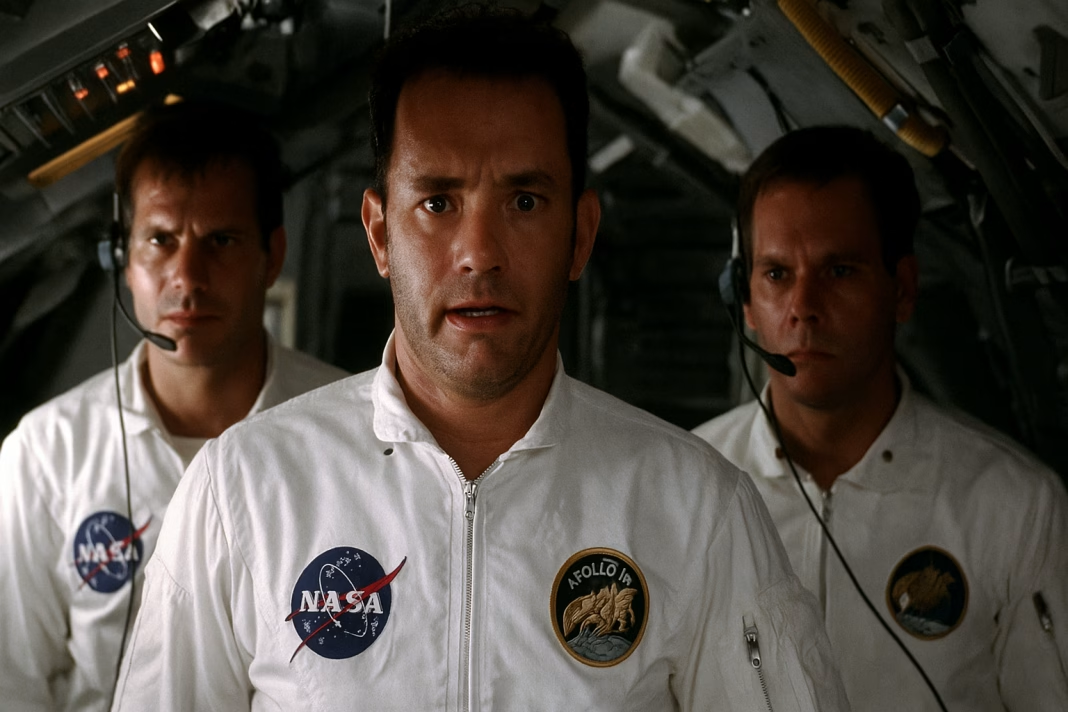

Apollo 13 is more than just a film about a failed moon mission — it’s a human story about courage, quick thinking, and teamwork in the face of disaster.
A Story of Space, Survival, and Teamwork
Directed by Ron Howard and starring Tom Hanks, Kevin Bacon, Bill Paxton, and Gary Sinise, the movie takes us back to April 1970, when NASA’s Apollo 13 mission suffered a life-threatening accident in space.
From the start, the movie sets the stage for the race to the moon. The U.S. and the Soviet Union were locked in a space race during the Cold War, each determined to prove their technological and political superiority. President John F. Kennedy famously challenged America to put a man on the moon before the decade ended, and NASA responded with the Apollo program. By 1969, the goal was achieved with Apollo 11, and astronaut Jim Lovell (played by Tom Hanks) watched the historic event with awe and excitement.
Lovell was originally set to fly on Apollo 14, but fate moved him up to command Apollo 13. The crew included Fred Haise (Bill Paxton) and Ken Mattingly (Gary Sinise). Just before the mission, Mattingly was exposed to measles and replaced by Jack Swigert (Kevin Bacon). The last-minute switch brought a small shadow of worry — a foreshadowing of the much bigger problems to come.
Howard’s film captures not just the technical side of space travel but also the emotional weight. We see Lovell’s wife having unsettling dreams about her husband’s safety and even losing her wedding ring down the drain, a moment that in real life really happened. These small personal details make the story relatable. Even though this was a massive NASA mission costing millions of dollars, at its heart it was also about human lives and their families waiting back home.
Disaster Strikes in the Most Unforgiving Place
The first part of Apollo 13 has an almost lighthearted feel. The crew floats in zero gravity — made possible by filming in NASA’s real “Vomit Comet” reduced-gravity plane — and even joke about bodily functions in space. There’s a sense of wonder, the joy of exploration, and a proud confidence in NASA’s abilities. But then, with one small routine procedure, everything changes.
When Swigert stirs the oxygen tanks, there’s an unexpected explosion. Systems start failing, oxygen levels drop, and electrical power becomes dangerously low. This is the moment we hear the now-famous line, “Houston, we have a problem,” though in reality the words were slightly different. The crew realizes they won’t be able to land on the moon — their new mission is simply to survive and get home.
The tension is gripping, even if you know the outcome. The movie makes the audience feel the claustrophobia of the spacecraft and the fear of drifting into the cold, dark void forever. It also shows the enormous pressure on the ground crew in Houston, racing to figure out solutions in real-time. One of the most memorable parts is watching engineers brainstorm using only the exact materials available on the spacecraft — a desperate but ingenious exercise in problem-solving.
Here, the film takes some dramatic liberties. According to the real Ken Mattingly, NASA’s response was more organized and less chaotic than the movie shows. The procedures had been practiced many times in simulations. But in storytelling terms, Howard’s choice makes sense — the urgency and confusion on screen pull the audience deeper into the drama.
The visual effects and set design deserve special praise. The space sequences look convincing, especially given that the film came out in 1995, long before today’s advanced CGI. The reduced-gravity shots are so real because, well, they are real. The cramped interiors, flickering instrument lights, and frost forming on the walls make you feel like you’re right there with the crew.
A Human Drama That Goes Beyond History
What makes Apollo 13 stand out isn’t just its accurate depiction of the mission, but how it balances historical detail with human emotion. Ron Howard and the cast manage to turn a well-known news story into an intimate and suspenseful journey.
Tom Hanks plays Jim Lovell as calm and determined, even under impossible pressure. Bill Paxton brings warmth and humor to Fred Haise, while Kevin Bacon captures the tension of being the last-minute substitute who finds himself in a crisis. Gary Sinise, as the grounded Ken Mattingly, becomes an unsung hero — working tirelessly from Earth to find solutions for his stranded colleagues.
One of the film’s strengths is that it avoids turning the astronauts into flawless heroes. They are skilled professionals, yes, but they’re also human — worried, tired, and occasionally frustrated. This human touch is essential because it reminds us that space missions are not just about rockets and technology; they’re about people making split-second decisions under extreme stress.
Historically, the movie gets high marks. It respects the facts of the mission, and while some scenes are dramatized, the overall sequence of events is faithful to reality. The famous line may be slightly altered, and some teamwork moments condensed into single characters for clarity, but the spirit of what happened remains true.
In the end, the crew makes it back to Earth safely, greeted as heroes despite not landing on the moon. The film closes not just with relief but with a deep respect for the bravery of everyone involved — from the astronauts to the engineers and flight controllers who worked around the clock.
Apollo 13 is both a thrilling survival story and a tribute to human ingenuity. It shows that in space, there’s no room for error — but with teamwork, creativity, and determination, even the most hopeless situations can be turned around. For anyone who loves history, adventure, or simply stories about people at their best when things are at their worst, this movie is well worth watching.