


India Pushes AI Innovation While Privacy Takes a Backseat
India is moving fast in adopting artificial intelligence (AI), especially facial recognition technology (FRT). At recent global AI meetings, India has shifted focus from “safety” to “innovation.” This shift shows the country’s push for faster development, fewer rules, and more space for experiments in new tech like FRT.
The Indian government plans to host the next AI Action Summit. This global event will highlight how India is leading in AI development. But at the same time, it allows the country to avoid hard questions about privacy and regulation.
While the Indian government promotes AI for progress, there’s little discussion on how this could harm citizens’ privacy. There are not many rules in place, and the laws that do exist give the government wide powers to collect and use personal data—even without permission. This creates an open environment where tech can grow quickly, but with fewer checks on how it affects people’s rights.
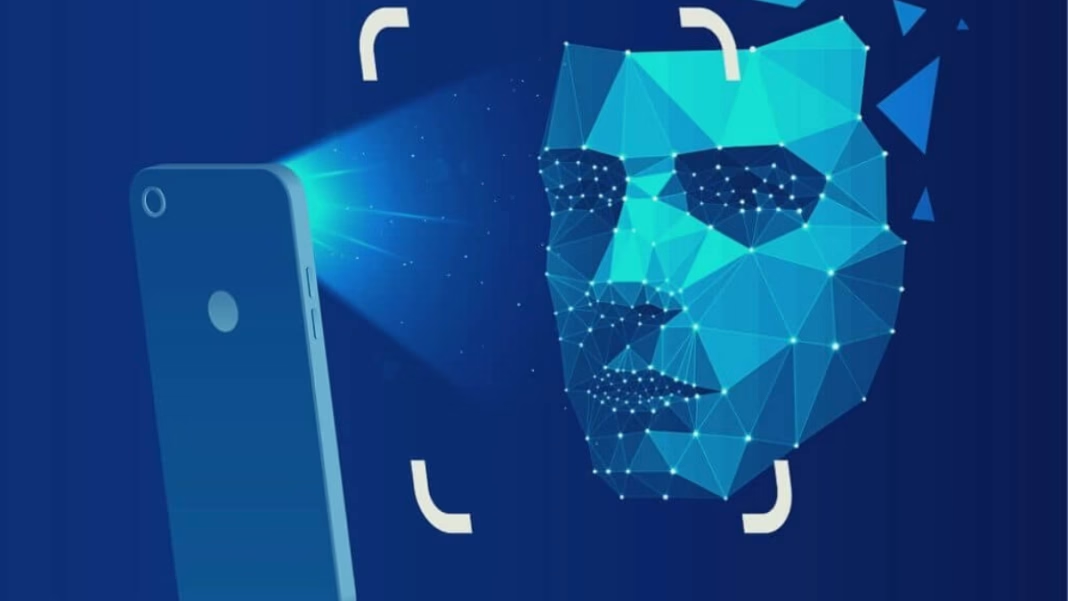
One area where this is very clear is facial recognition. It’s already being used across India—on streets, at public places, and in offices. It helps identify people through live video or photographs by scanning their faces. It’s fast, high-tech, and effective in many cases. But it’s also risky, especially without strong privacy laws.
Facial Recognition Tech Expands Rapidly Without Strong Rules
Facial recognition technology uses artificial intelligence to scan faces and compare them with images stored in a database. The system learns to recognize faces using deep learning, a method where the computer improves its guesses over time.
In India, facial recognition is being used widely by both public and private organisations. It’s used in schools to mark attendance, by police to track suspects, and even in offices for login and access.
Experts warn that this technology is not always accurate. It can make mistakes—sometimes matching the wrong person or missing someone completely. Lighting, face angles, or expressions can confuse the system.
🛡️ 500M cyber strikes after peace deal – Thai and Cambodian hackers launch cyber blitz
In India, where over a billion people live, such errors could affect many innocent individuals. Despite this, the government is investing heavily in this technology, including tools that link facial recognition with large national databases. This goes against a key privacy principle called “data minimisation,” which says only necessary information should be collected and stored.
The government’s tenders for facial recognition systems have even asked for integration with other databases, creating one large profile per citizen. This kind of setup can allow for deep surveillance and tracking of individuals across different parts of their lives—without their knowledge.
India’s Privacy Laws Offer Few Protections Against Misuse
India does have a new law called the Digital Personal Data Protection Act. But this law has many gaps. It allows the government to collect and use personal data without asking people first. This includes reasons like “national security,” “public order,” or “sovereignty,” which are very broad and vague terms.
The law lets some government departments use personal data freely. They don’t have to follow the same rules as others. This means that even if rules exist, many agencies can ignore them.
A policy paper called “Responsible AI for All” says that privacy issues with facial recognition will be handled by the new data law. But the paper does not give clear rules or protections.
The Supreme Court has said that privacy is a basic right. It also said that if privacy is limited, it must be for a good reason. The method must be fair and should not harm more than needed.
India is now welcoming big AI companies and building large data centers. But it is still not making strong rules. This may help bring more business. However, it also brings big risks of spying and losing personal privacy.