
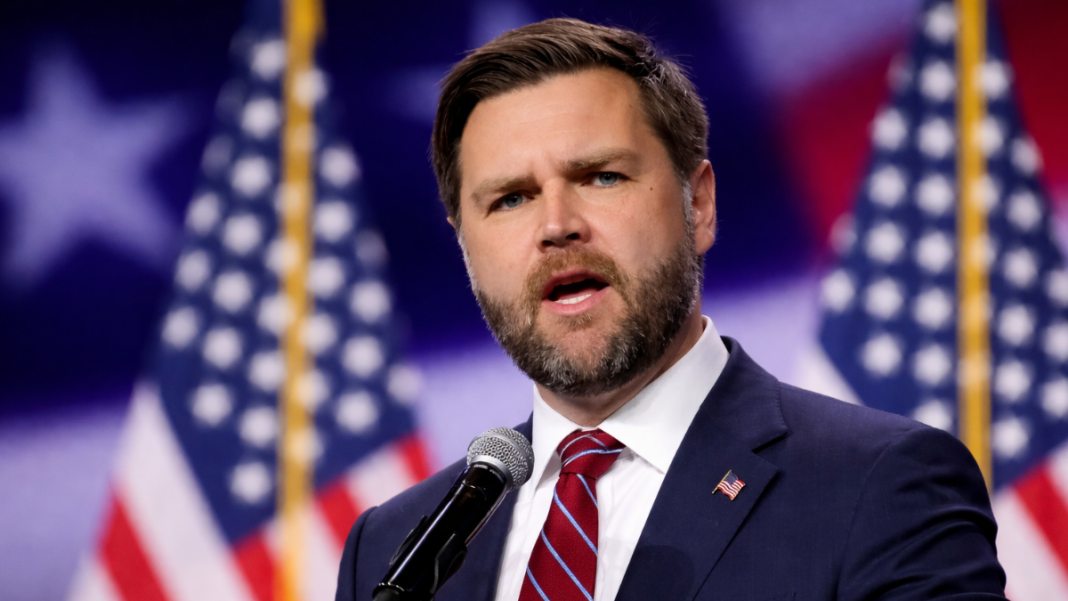

Vice President JD Vance has sparked strong political discussion after making a sharp comment about the Democratic Party’s future during a televised interview. While speaking on a prime-time show hosted by Jesse Watters, Vance claimed that the Democratic presidential nomination in 2028 would likely be won by what he called the “dumbest” candidate. The remark, delivered with humor but backed by pointed criticism, quickly became a talking point across political circles.
The comment came as part of a broader discussion about possible Democratic contenders and the direction of the party. Although the exchange included jokes, Vance used the moment to outline serious concerns he believes exist within Democratic leadership and priorities. His remarks focused on qualifications, governance, and economic responsibility rather than campaign strategy or election predictions.
JD Vance Targets Democratic Leadership and Party Direction
During the interview, Jesse Watters raised the topic of potential Democratic figures who may seek the presidency in 2028. The conversation briefly touched on public appearances before turning to a more direct political question about who might win a Democratic primary.
Bowman’s ballot controversy rattles Cincinnati race — and tests JD Vance’s political brand
JD Vance said he believes the “dumbest candidate will probably win” the Democratic nomination, a remark he made while laughing but later expanded upon. He argued that the Democratic Party places greater emphasis on ideological messaging than on leadership ability and effective governance.
Vance named Gavin Newsom and Kamala Harris as examples of what he described as deeper problems within the party. He claimed Harris is not qualified for the presidency and criticized Newsom’s record as governor, saying their status as frontrunners shows a disconnect between Democratic leadership and the concerns of everyday Americans.
Economic Claims and Criticism of Democratic Policies
The interview also addressed the issue of rising living costs, which remains one of the most important concerns for voters. Jesse Watters noted that Democrats are expected to campaign heavily on affordability issues such as food prices, rent, and general cost of living.
Joe Rogan breaks ranks, says Kamala Harris was capable of a full three-hour unscripted interview
JD Vance argued that Democrats are responsible for the economic problems they now criticize. He described their approach as hypocritical and said past Democratic policies contributed to inflation and higher household expenses, which continue to affect many Americans.
Vance said that under the current administration led by Donald Trump, economic conditions have begun to improve. He pointed to signs such as stabilizing prices, easing rents in some areas, and slower growth in grocery costs, while acknowledging that further work is still needed.
Impeachment Talk and Political Response
When asked whether Democrats would attempt to impeach Donald Trump again if they regain power in Congress, JD Vance said he believed such a move would be almost guaranteed. He described impeachment efforts as politically driven and claimed Democrats lack meaningful policy goals beyond opposing Trump.
Vance argued that Democrats, if given power, would not focus on lowering taxes, improving safety, or reducing crime. Instead, he said they would spend time and public money targeting the president. He framed this approach as unproductive and disconnected from voters’ real needs.
Following the interview, Gavin Newsom’s office responded in a nontraditional way. Rather than issuing a formal statement, the office shared a humorous, digitally altered image online that mocked Vance, referencing an earlier joke made during the interview. The response added a lighter tone to the exchange but also kept the spotlight on Vance’s remarks.
The episode highlights how sharp language, humor, and media moments are increasingly shaping political conversations. JD Vance’s comments, while controversial, centered on his criticism of Democratic leadership, party priorities, and economic responsibility, keeping attention firmly on his message rather than the mechanics of future elections.