

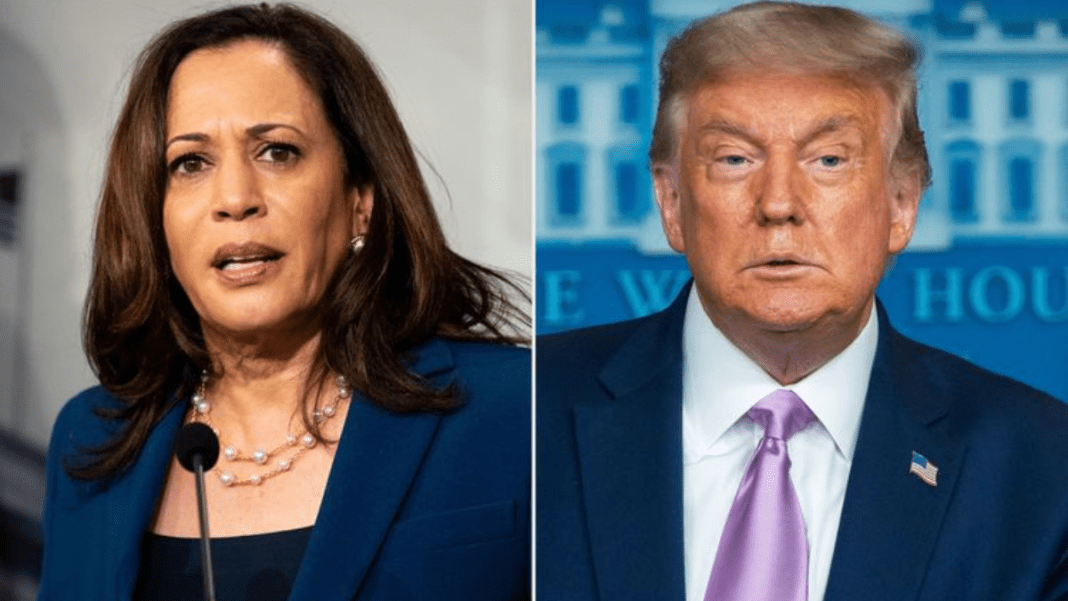

Harris hails Jimmy Kimmel suspension fightback as proof of people’s power against Trump

Former Vice President Kamala Harris gave her first television interview since leaving office in January 2025. The 40-minute sit-down aired on MSNBC on September 23 with host Rachel Maddow. Fox News later ran a shorter 2-3 minute clip highlighting her strongest remarks.

Harris’s First TV Interview Since Leaving Office

In the clip, Harris directly attacked President Donald Trump’s leadership in his second term. She accused him of being a “tyrant” and compared his style of rule to that of communist dictators. Her comments centered on threats to U.S. democracy, the silence of business leaders, and the power of ordinary citizens to push back against abuses of authority.

Harris spoke in a calm but firm tone, as she leaned forward in the studio to stress her points. Maddow asked her about the current state of democracy under Trump, prompting Harris to answer with sharp criticism of both the president and those she believes have failed to hold him accountable.

Calling Trump a Tyrant and Drawing Historical Parallels

Harris repeated a label she had used earlier this year when speaking near the Ellipse, the site of the January 6 Capitol riot. She said, “Right now we are dealing with, as I called him at my speech on the Ellipse, a tyrant.”

She argued that Trump uses federal agencies to settle personal scores. According to Harris, his decisions are driven more by a “fragile ego” than by concern for the American people. She warned that this behavior places the country at risk of sliding into authoritarianism.

From Trump stronghold to Sanders territory? West Virginia coal country sparks political earthquake

In one of the most striking parts of the interview, Harris compared Trump to communist leaders from the Cold War era. She said, “We used to compare the strength of our democracy to communist dictators. That’s what we’re dealing with right now in Donald Trump.” She explained that his administration suppresses dissent, weakens checks and balances, and fosters fear.

The clip showed Harris stressing that the U.S., once seen as a model of democracy, now faces challenges similar to those faced under authoritarian systems. Her words echoed themes she raised during her 2024 campaign, but she sharpened her tone after nine months of Trump’s second presidency.

Criticism of Business Leaders and Praise for Public Pushback

Harris also took aim at America’s business leaders. She accused CEOs and corporate executives of failing to speak up during what she described as a critical time. “They have been silent,” she said, adding, “Yes, I use the word feckless. It’s not like they’re gonna lose their yacht or their house in the Hamptons.”

She called on these leaders to act as “guardrails” to protect democratic institutions. She argued that companies and executives should stand against a president who, in her words, “is using the federal government to execute his whim and fancy because of a fragile ego.”

Harris then turned her attention to public action, pointing to the recent suspension of late-night host Jimmy Kimmel. Kimmel’s show was briefly pulled off the air after he mocked Trump’s policies in a monologue. However, public outrage, boycotts, and social media campaigns pushed.

Gavin Newsom warns of coordinated effort after ABC halts Jimmy Kimmel Live citing FCC pressure

Disney to reinstate him. Harris praised this outcome, saying, “We saw the power of the people over the last few days, and it spoke volumes, and it moved a decision in the right direction.”

She framed this as proof that ordinary citizens still have influence. By using their voices and even their wallets, she said, they could push back against what she described as threats to democracy.

The Fox News clip ended on a defiant note. Harris urged viewers to recognize what she called the stakes of the moment, saying that resisting now could prevent what she fears could become irreversible tyranny.


Pearl Croft
Pearl Crofthttps://newsinterpretation.com
I am Pearl Croft I give “News Interpretation” an insight into the most recent news hitting the “Consumer Goods” sector in Wall Street. I have been an independent financial adviser for over 11 years in the city and in recent years turned my experience in finance and passion for journalism into a full time role. I perform analysis of Companies and publicize valuable information for shareholder community. But writing about the political developments is my hobby.

TOP 10 TRENDING ON NEWSINTERPRETATION

Cyber Attacks on Space Infrastructure: Satellites, GPS and the Ground Systems Behind Them

From the Viasat KA-SAT hack to GPS jamming over the Baltic, a research guide to how attackers target satellites, navigation signals and ground stations, and why it matters on Earth.

How AI Agents Are Used in Cyber Attacks: From Assisted Hacking to AI-Orchestrated Espionage

Attackers now use AI agents to scan networks, write exploits and run extortion campaigns. A research guide to documented cases, including the first reported AI-orchestrated espionage campaign, and what defenders should do.

Cyber Attacks on AI and LLMs: How Attackers Target Large Language Models

Prompt injection, data poisoning, model theft and jailbreaks: a research guide to how attackers target AI systems and large language models, with real cases and defences.

French Supermarket Refrigeration Cyberattack: How Hacking the Cold Chain Can Endanger Lives

In October 2026 attackers heated refrigeration cabinets in hundreds of French supermarkets to as much as 50°C. No one was hurt, but the attack shows how hacking the cold chain can endanger lives through fire, food poisoning and spoiled medicines.

Cyberattacks on Nuclear Facilities: Stuxnet, Kudankulam and the Limits of Air Gaps

Stuxnet, the Davis-Besse worm and malware at India’s Kudankulam plant: what they show about cyber risk at nuclear facilities and the limits of air gaps.

Triton: When Hackers Target the Safety Systems That Prevent Industrial Disasters

The 2017 Triton attack targeted the safety systems that prevent industrial disasters. What happened, who was charged, and how plants protect their last line of defence.

Cybersecurity Risks in Smart Cities: When Connected Infrastructure Fails

How connecting traffic control, emergency alerts and utilities concentrates cyber risk in cities, what the Dallas and Atlanta incidents showed, and what governments recommend.

Weaponized Drones: Hijacking, GPS Spoofing and Emerging Cyber Warfare Risks

How drones can be hijacked, jammed or misled by GPS spoofing, what researchers have demonstrated, and why governments treat drone fleets as a security risk.

Ransomware Attacks on Hospitals: How Healthcare Cyberattacks Put Patients at Risk

How ransomware against hospitals and their suppliers delays care and endangers patients, what the Düsseldorf and WannaCry cases show, and what research says about deaths.

Operational blunder exposes massive Russian cyber espionage attack on Ukrainian prosecutors

A major cyberattack has compromised the email accounts of...

Cyber Attacks on Space Infrastructure: Satellites, GPS and the Ground Systems Behind Them

From the Viasat KA-SAT hack to GPS jamming over the Baltic, a research guide to how attackers target satellites, navigation signals and ground stations, and why it matters on Earth.

French Supermarket Refrigeration Cyberattack: How Hacking the Cold Chain Can Endanger Lives

In October 2026 attackers heated refrigeration cabinets in hundreds of French supermarkets to as much as 50°C. No one was hurt, but the attack shows how hacking the cold chain can endanger lives through fire, food poisoning and spoiled medicines.

Cyberattacks on Nuclear Facilities: Stuxnet, Kudankulam and the Limits of Air Gaps

Stuxnet, the Davis-Besse worm and malware at India’s Kudankulam plant: what they show about cyber risk at nuclear facilities and the limits of air gaps.

Triton: When Hackers Target the Safety Systems That Prevent Industrial Disasters

The 2017 Triton attack targeted the safety systems that prevent industrial disasters. What happened, who was charged, and how plants protect their last line of defence.

Cybersecurity Risks in Smart Cities: When Connected Infrastructure Fails

How connecting traffic control, emergency alerts and utilities concentrates cyber risk in cities, what the Dallas and Atlanta incidents showed, and what governments recommend.

Ransomware Attacks on Hospitals: How Healthcare Cyberattacks Put Patients at Risk

How ransomware against hospitals and their suppliers delays care and endangers patients, what the Düsseldorf and WannaCry cases show, and what research says about deaths.

FBI warns of AVrecon malware targeting outdated routers linked to proxy based cybercrime

A serious cybersecurity warning has been issued regarding commonly...

Related Articles

Popular Categories
