

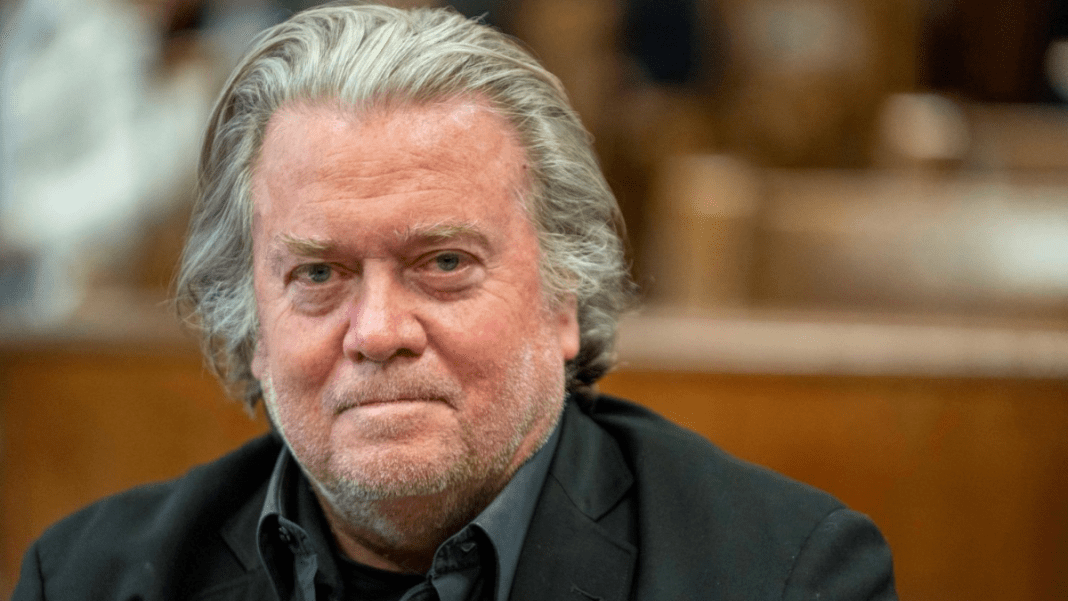
Bannon ignites firestorm after claiming one-third of U.S. teachers are “terrorists” shaping kids

Steve Bannon, the former adviser to Donald Trump, stunned audiences with a bold statement during a memorial service for right-wing activist Charlie Kirk.

Steve Bannon Labels Teachers ‘Terrorists’

Speaking from a large gathering in Arizona on Sunday, Bannon called a portion of American teachers “terrorists” while praising Kirk’s values on marriage, family, and early parenthood.

The controversial remarks came during a broadcast on the conservative network Real America’s Voice. Bannon appeared alongside co-host Gina Loudon, who was highlighting Kirk’s “throwback ideas,” such as encouraging young marriage and having multiple children. Loudon noted that Kirk’s ideals are “not popular on college campuses right now.” Bannon quickly pushed back, making his startling claim about teachers.

“Well, I actually think they are popular,” Bannon said, “but it’s not the way those kids—look, from kindergarten all the way up, they are essentially, you know, a third of the teachers are terrorists that are trying to form them.” Loudon responded in agreement, echoing his words on air.

Bannon, 71, said that young people still seek out Kirk’s ideals despite what he called “radical” teaching. “You’re bad, you’re everything evil, you’ve gotta change, we have to change you, we have to give you drugs,” he said, referring primarily to young guys. He suggested that these lessons oppose values like family life, early marriage, and fatherhood.

Reaction Tied to Rising Political Tensions

Bannon’s comments come after the tragic murder of Charlie Kirk at a Utah college campus. In recent weeks, several MAGA figures have described the left as a growing “terrorist” threat. Bannon framed Kirk’s death as part of a larger conflict, declaring, “Charlie Kirk is a casualty of war. We are at war in this country.”

Mary Kirk, once unknown as Charlie Kirk’s sister, now stands with Bernie Sanders’ progressive movement

Other prominent Trump allies have echoed this language. The government will employ “every resource” to attack what he described as left-wing “terrorist networks,” according to White House Deputy Chief of Staff Stephen Miller. Similar remarks were made by Vice President JD Vance in support of this approach.

Meanwhile, President Donald Trump announced that he would designate the decentralized political movement Antifa as a terrorist organization. This move has drawn criticism from various leaders, who argue that the government is using claims of terrorism to target political opponents. California Governor Gavin Newsom, for instance, pointed out that Miller recently described the Democratic Party as a “domestic extremist organization.”

Bannon Highlights Family and Conservative Values

During his tribute, Bannon emphasized Kirk’s commitment to traditional family structures and early parenthood. He claimed that young people still seek out Kirk’s values despite the pressure from educational institutions. According to Bannon, teaching that criticizes boys and young men as “bad” or in need of reform stands in opposition to family-centered values.

Karoline Leavitt shares post linking Utah earthquake to Charlie Kirk death timing

He framed these issues as central to understanding the cultural divide in America. Bannon’s speech connected Kirk’s ideas to larger debates over parenting, education, and the upbringing of children. He argued that fostering family values, getting married early, and being a good parent are acts of resistance against what he perceives as radical influence in schools.


Bannon’s remarks have sparked widespread discussion. They have drawn attention to heated talks about education and politics in the United States. He called teachers “terrorists,” which has fueled debates. People are talking about how young Americans are taught. They are also questioning the role of schools in shaping values.

Renuka Bangale
Renuka Bangale
Renuka is a distinguished Chartered Accountant and a Certified Digital Threats Analyst from Riskpro, renowned for her expertise in cybersecurity. With a deep understanding of cybercrimes, malware, cyber warfare, and espionage, she has established herself as an authority in the field. Renuka combines her financial acumen with advanced knowledge of digital threats to provide unparalleled insights into the evolving landscape of information security. Her analytical prowess enables her to dissect complex cyber incidents, offering clarity on risks and mitigation strategies. As a key contributor to Newsinterpretation’s information security category, Renuka delivers authoritative articles that educate and inform readers about emerging threats and best practices.

TOP 10 TRENDING ON NEWSINTERPRETATION

Cyber Attacks on Space Infrastructure: Satellites, GPS and the Ground Systems Behind Them

From the Viasat KA-SAT hack to GPS jamming over the Baltic, a research guide to how attackers target satellites, navigation signals and ground stations, and why it matters on Earth.

How AI Agents Are Used in Cyber Attacks: From Assisted Hacking to AI-Orchestrated Espionage

Attackers now use AI agents to scan networks, write exploits and run extortion campaigns. A research guide to documented cases, including the first reported AI-orchestrated espionage campaign, and what defenders should do.

Cyber Attacks on AI and LLMs: How Attackers Target Large Language Models

Prompt injection, data poisoning, model theft and jailbreaks: a research guide to how attackers target AI systems and large language models, with real cases and defences.

French Supermarket Refrigeration Cyberattack: How Hacking the Cold Chain Can Endanger Lives

In October 2026 attackers heated refrigeration cabinets in hundreds of French supermarkets to as much as 50°C. No one was hurt, but the attack shows how hacking the cold chain can endanger lives through fire, food poisoning and spoiled medicines.

Cyberattacks on Nuclear Facilities: Stuxnet, Kudankulam and the Limits of Air Gaps

Stuxnet, the Davis-Besse worm and malware at India’s Kudankulam plant: what they show about cyber risk at nuclear facilities and the limits of air gaps.

Triton: When Hackers Target the Safety Systems That Prevent Industrial Disasters

The 2017 Triton attack targeted the safety systems that prevent industrial disasters. What happened, who was charged, and how plants protect their last line of defence.

Cybersecurity Risks in Smart Cities: When Connected Infrastructure Fails

How connecting traffic control, emergency alerts and utilities concentrates cyber risk in cities, what the Dallas and Atlanta incidents showed, and what governments recommend.

Weaponized Drones: Hijacking, GPS Spoofing and Emerging Cyber Warfare Risks

How drones can be hijacked, jammed or misled by GPS spoofing, what researchers have demonstrated, and why governments treat drone fleets as a security risk.

Ransomware Attacks on Hospitals: How Healthcare Cyberattacks Put Patients at Risk

How ransomware against hospitals and their suppliers delays care and endangers patients, what the Düsseldorf and WannaCry cases show, and what research says about deaths.

Operational blunder exposes massive Russian cyber espionage attack on Ukrainian prosecutors

A major cyberattack has compromised the email accounts of...

Cyber Attacks on Space Infrastructure: Satellites, GPS and the Ground Systems Behind Them

From the Viasat KA-SAT hack to GPS jamming over the Baltic, a research guide to how attackers target satellites, navigation signals and ground stations, and why it matters on Earth.

French Supermarket Refrigeration Cyberattack: How Hacking the Cold Chain Can Endanger Lives

In October 2026 attackers heated refrigeration cabinets in hundreds of French supermarkets to as much as 50°C. No one was hurt, but the attack shows how hacking the cold chain can endanger lives through fire, food poisoning and spoiled medicines.

Cyberattacks on Nuclear Facilities: Stuxnet, Kudankulam and the Limits of Air Gaps

Stuxnet, the Davis-Besse worm and malware at India’s Kudankulam plant: what they show about cyber risk at nuclear facilities and the limits of air gaps.

Triton: When Hackers Target the Safety Systems That Prevent Industrial Disasters

The 2017 Triton attack targeted the safety systems that prevent industrial disasters. What happened, who was charged, and how plants protect their last line of defence.

Cybersecurity Risks in Smart Cities: When Connected Infrastructure Fails

How connecting traffic control, emergency alerts and utilities concentrates cyber risk in cities, what the Dallas and Atlanta incidents showed, and what governments recommend.

Ransomware Attacks on Hospitals: How Healthcare Cyberattacks Put Patients at Risk

How ransomware against hospitals and their suppliers delays care and endangers patients, what the Düsseldorf and WannaCry cases show, and what research says about deaths.

FBI warns of AVrecon malware targeting outdated routers linked to proxy based cybercrime

A serious cybersecurity warning has been issued regarding commonly...

Related Articles

Popular Categories
