

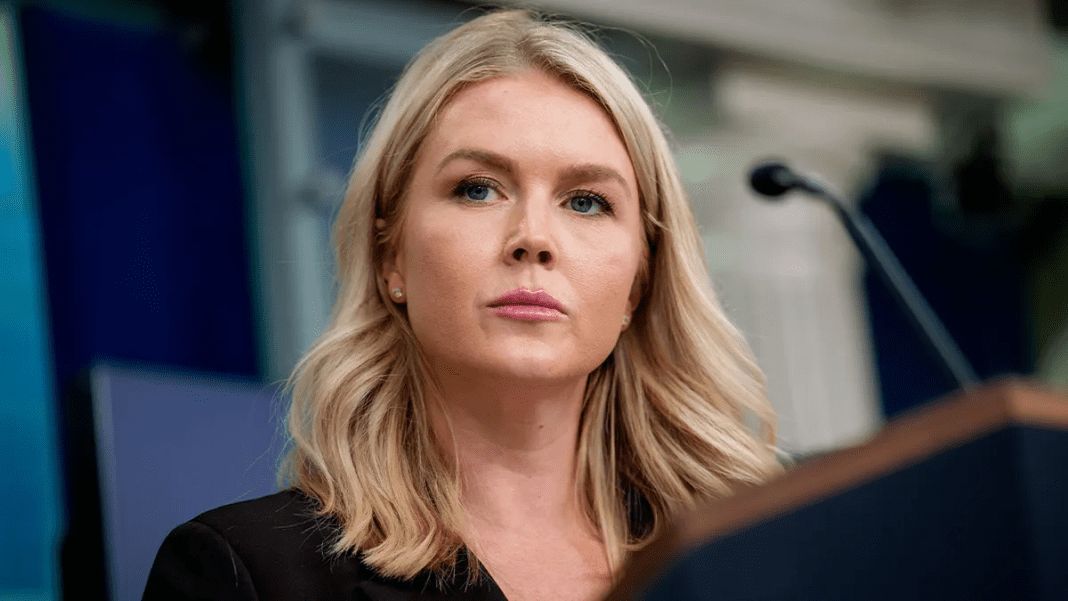

Karoline Leavitt fires back at Fox News — denies claim that U.S. troops are headed to Israel

Tension erupted in Washington after White House Press Secretary Karoline Leavitt tried to correct Fox News and ended up causing more confusion. The issue began when President Donald Trump announced a new peace deal between Israel and Hamas, described as the “first phase” of a 20-point plan to end the war in Gaza. The agreement focused on releasing Israeli hostages in exchange for Palestinians held in Israeli prisons.

Shortly after the announcement, Fox News posted a breaking news alert on its official X (formerly Twitter) account that read: “BREAKING: US troops headed to Israel to support historic peace deal.” The post quickly spread online, gaining massive attention within minutes.

The White House was quick to respond. Karoline Leavitt replied publicly, saying the claim was “NOT true and taken out of context.” She explained that up to 200 U.S. personnel already stationed at the United States Central Command (CENTCOM) would be tasked with monitoring the peace agreement. These individuals, she added, would work alongside other international forces already present in the region.

Karoline Leavitt aggressively defends federal response as judge blocks National Guard deployment to Oregon

Leavitt’s message was meant to clarify that there was no new troop deployment or escalation of military presence in the Middle East. However, instead of settling the issue, her statement stirred widespread confusion.

Online Reactions Turn the Tables

Leavitt’s post quickly went viral, drawing mixed reactions from social media users. Many pointed out that her explanation seemed to confirm what Fox News had initially reported. Comments poured in questioning the contradiction between her claim that the report was “not true” and her admission that U.S. personnel would, in fact, be in Israel as part of the peace process.

One user wrote, “Then it is true, you just provided more details.” Another asked, “How can something be not true and taken out of context at the same time?” The exchange spread rapidly, with thousands joining the discussion and questioning the White House’s communication strategy.

The confusion centered on interpretation. Fox News stated that U.S. troops were “headed to Israel,” while Leavitt insisted they were “already stationed in the region.” Technically, both statements were correct depending on perspective. The disagreement came down to how the situation was framed.

For many, the phrase “US troops headed to Israel” implied a new deployment, raising concerns about further military involvement. In contrast, Leavitt’s clarification emphasized that no new forces were being sent and that those involved would only monitor and support the ceasefire process.

Heated clash erupts as reporters corner press secretary Karoline Leavitt over ‘free health care’ shutdown spin

Clarifications Follow, But Questions Linger

About 45 minutes after Leavitt’s response, Fox News posted a follow-up update to address the confusion. The network clarified that the United States planned to utilize up to 200 troops already based in the Middle East to help monitor the ceasefire in Gaza, as part of a multinational peace support team.

According to The New York Times, those U.S. personnel will help establish a civil-military coordination center inside Israel. Their mission is to assist with humanitarian operations and ensure security for aid delivery under the ceasefire agreement. None of the troops are expected to enter Gaza or participate in combat activities.

Despite the updated information, Leavitt’s sharp response continued to attract attention. Observers noted the irony of her dispute with Fox News, a network typically viewed as favorable toward the Trump administration. Many speculated that her quick reaction stemmed from a desire to prevent any misunderstanding among supporters wary of U.S. military involvement overseas.

The incident highlighted how a small difference in wording can create a major online debate. What began as a clarification from the White House turned into a viral moment that overshadowed the peace deal itself. In trying to fact-check the report, Karoline Leavitt unintentionally reinforced the same point she was disputing — that U.S. troops connected to CENTCOM would indeed be operating in Israel to help oversee the peace process.

The exchange between Leavitt and Fox News shows how quickly official statements can spiral on social media, especially when national security and foreign policy are involved.


Pearl Croft
Pearl Crofthttps://newsinterpretation.com
I am Pearl Croft I give “News Interpretation” an insight into the most recent news hitting the “Consumer Goods” sector in Wall Street. I have been an independent financial adviser for over 11 years in the city and in recent years turned my experience in finance and passion for journalism into a full time role. I perform analysis of Companies and publicize valuable information for shareholder community. But writing about the political developments is my hobby.

TOP 10 TRENDING ON NEWSINTERPRETATION

Cyber Attacks on Space Infrastructure: Satellites, GPS and the Ground Systems Behind Them

From the Viasat KA-SAT hack to GPS jamming over the Baltic, a research guide to how attackers target satellites, navigation signals and ground stations, and why it matters on Earth.

How AI Agents Are Used in Cyber Attacks: From Assisted Hacking to AI-Orchestrated Espionage

Attackers now use AI agents to scan networks, write exploits and run extortion campaigns. A research guide to documented cases, including the first reported AI-orchestrated espionage campaign, and what defenders should do.

Cyber Attacks on AI and LLMs: How Attackers Target Large Language Models

Prompt injection, data poisoning, model theft and jailbreaks: a research guide to how attackers target AI systems and large language models, with real cases and defences.

French Supermarket Refrigeration Cyberattack: How Hacking the Cold Chain Can Endanger Lives

In October 2026 attackers heated refrigeration cabinets in hundreds of French supermarkets to as much as 50°C. No one was hurt, but the attack shows how hacking the cold chain can endanger lives through fire, food poisoning and spoiled medicines.

Cyberattacks on Nuclear Facilities: Stuxnet, Kudankulam and the Limits of Air Gaps

Stuxnet, the Davis-Besse worm and malware at India’s Kudankulam plant: what they show about cyber risk at nuclear facilities and the limits of air gaps.

Triton: When Hackers Target the Safety Systems That Prevent Industrial Disasters

The 2017 Triton attack targeted the safety systems that prevent industrial disasters. What happened, who was charged, and how plants protect their last line of defence.

Cybersecurity Risks in Smart Cities: When Connected Infrastructure Fails

How connecting traffic control, emergency alerts and utilities concentrates cyber risk in cities, what the Dallas and Atlanta incidents showed, and what governments recommend.

Weaponized Drones: Hijacking, GPS Spoofing and Emerging Cyber Warfare Risks

How drones can be hijacked, jammed or misled by GPS spoofing, what researchers have demonstrated, and why governments treat drone fleets as a security risk.

Ransomware Attacks on Hospitals: How Healthcare Cyberattacks Put Patients at Risk

How ransomware against hospitals and their suppliers delays care and endangers patients, what the Düsseldorf and WannaCry cases show, and what research says about deaths.

Operational blunder exposes massive Russian cyber espionage attack on Ukrainian prosecutors

A major cyberattack has compromised the email accounts of...

Cyber Attacks on Space Infrastructure: Satellites, GPS and the Ground Systems Behind Them

From the Viasat KA-SAT hack to GPS jamming over the Baltic, a research guide to how attackers target satellites, navigation signals and ground stations, and why it matters on Earth.

French Supermarket Refrigeration Cyberattack: How Hacking the Cold Chain Can Endanger Lives

In October 2026 attackers heated refrigeration cabinets in hundreds of French supermarkets to as much as 50°C. No one was hurt, but the attack shows how hacking the cold chain can endanger lives through fire, food poisoning and spoiled medicines.

Cyberattacks on Nuclear Facilities: Stuxnet, Kudankulam and the Limits of Air Gaps

Stuxnet, the Davis-Besse worm and malware at India’s Kudankulam plant: what they show about cyber risk at nuclear facilities and the limits of air gaps.

Triton: When Hackers Target the Safety Systems That Prevent Industrial Disasters

The 2017 Triton attack targeted the safety systems that prevent industrial disasters. What happened, who was charged, and how plants protect their last line of defence.

Cybersecurity Risks in Smart Cities: When Connected Infrastructure Fails

How connecting traffic control, emergency alerts and utilities concentrates cyber risk in cities, what the Dallas and Atlanta incidents showed, and what governments recommend.

Ransomware Attacks on Hospitals: How Healthcare Cyberattacks Put Patients at Risk

How ransomware against hospitals and their suppliers delays care and endangers patients, what the Düsseldorf and WannaCry cases show, and what research says about deaths.

FBI warns of AVrecon malware targeting outdated routers linked to proxy based cybercrime

A serious cybersecurity warning has been issued regarding commonly...

Related Articles

Popular Categories
