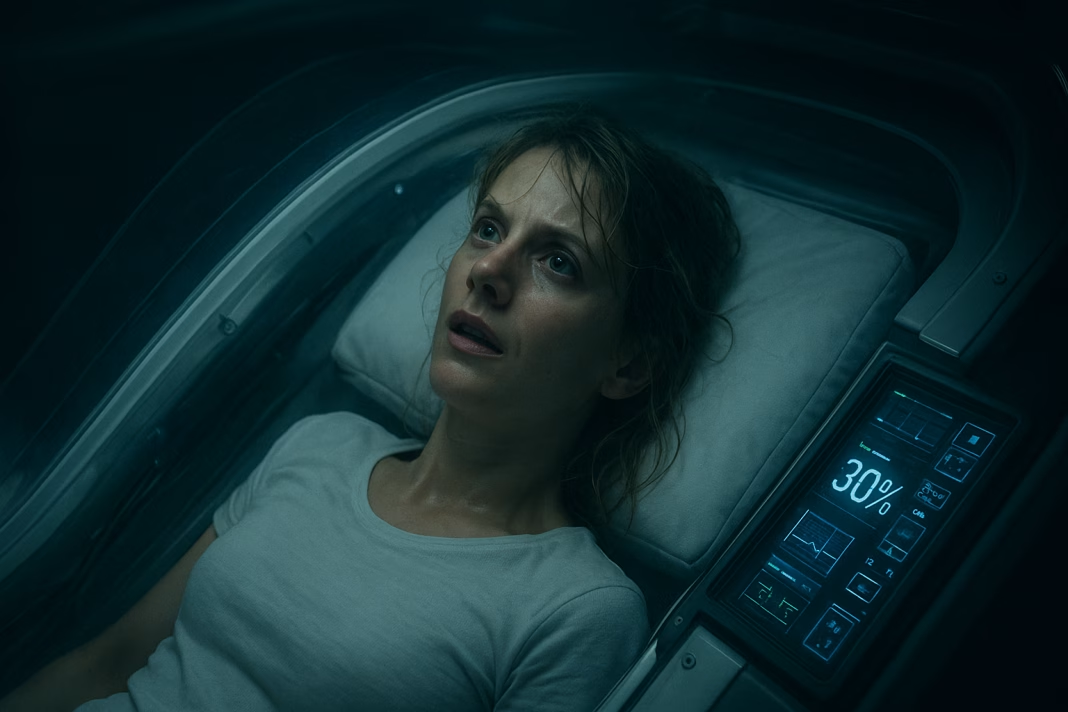

Alexandre Aja’s Oxygen is a survival thriller that thrives on a deceptively simple premise: a woman wakes up in a cryogenic pod with her memory wiped, a dwindling oxygen supply, and no way out. The story is confined to a single location—a coffin-like capsule lined with monitors, wires, and cold metallic edges. The tension comes from the shrinking numbers on the oxygen gauge, ticking away in real time, forcing the audience to feel the same suffocating pressure as the protagonist.
At first glance, the setup is gripping. The combination of technological precision and the primal fear of running out of air creates an immediate hook. Yet, while the concept promises raw intensity, the execution leans heavily on a suspension of disbelief that not every viewer will find easy to maintain.
Mélanie Laurent’s Performance as the Saving Grace
Mélanie Laurent carries the entire film on her shoulders, and it is fair to say that without her presence, Oxygen would collapse under its own implausibility. She portrays a woman trapped between panic and determination with convincing fragility. Her performance captures the disorientation of someone who doesn’t know their name, past, or purpose, but who must summon extraordinary willpower to survive.
The script gives her little room to move—literally—but Laurent makes use of every gasp, twitch, and desperate plea. The camera often lingers on her face, and in those close-ups, she communicates a raw cocktail of emotions: fear, confusion, and the slow evolution into resilience. It’s a performance that anchors the film in humanity, even when the plot strains credibility.
Unfortunately, the script does not always meet Laurent’s performance with equal depth. Much of her dialogue is directed at MILO, the onboard AI system voiced with smooth detachment by Mathieu Amalric. This dynamic provides some of the film’s most engaging moments, as the AI alternates between helpful instructions and unsettlingly evasive answers. But after a while, the exchanges feel repetitive, and the narrative tension begins to wobble.
The Problem with Style Over Substance
Oxygen is undeniably stylish. Aja crafts claustrophobia with precision: the pod feels like both a futuristic machine and a coffin, reminding viewers of mortality with every beep of a monitor. The cinematography finds inventive angles in the cramped space, ensuring the visual monotony never fully sets in.
However, style cannot mask the cracks in the script. The film asks for enormous leaps of faith from its audience. Amnesia conveniently explains away missing information. Flashbacks arrive in sudden bursts but often confuse rather than clarify. The science itself is stretched thin, with several elements bordering on the absurd. Instead of being immersed in the thriller, one often finds themselves asking, “Would this really happen?” And in a film that relies so much on its premise, too many unanswered questions leave the experience unsatisfying.
The comparison to Rodrigo Cortés’s Buried (2010) is inevitable. That film thrived on minimalism, grounding its tension in a terrifyingly believable scenario. By contrast, Oxygen leans into high-concept science fiction but never quite reconciles its human story with its technological backdrop. The result is a thriller that feels both ambitious and over-engineered.
A Film of Its Time, but Not Without Flaws
Some may see Oxygen as unintentionally reflective of the COVID-19 era, where breathing itself became a collective anxiety. Watching a character fight for air inside a sealed pod is bound to stir uncomfortable associations. Yet the film sidesteps any overt commentary, choosing instead to keep the story in the realm of speculative fiction. This decision keeps the narrative from becoming opportunistic, but it also robs it of thematic weight.
What remains is a high-concept thriller that delivers moments of ingenuity but often suffocates under its own ambitions. The real-time structure, the confined setting, and the countdown to zero are undeniably effective devices, but they cannot fully distract from the contrived twists and leaps in logic.
Final Thoughts
Oxygen is a film that works best when experienced as pure entertainment rather than scrutinized for logic. As a claustrophobic nightmare, it succeeds in raising heart rates and delivering a handful of clever turns. But as a science fiction drama that aims for depth, it falters. The movie feels like a puzzle box that looks intricate from the outside but reveals too many missing pieces once opened.
Mélanie Laurent’s compelling performance is the oxygen that keeps the film alive, while Alexandre Aja’s direction ensures the visuals remain sharp and engaging. Yet the script, weighed down by implausibility, prevents the film from reaching the greatness it aspires to.
For viewers who enjoy tense, single-location thrillers, Oxygen may still provide a suffocating ride worth taking. But for those seeking coherence and a story that holds up under scrutiny, it may leave them gasping for more than the film can deliver.