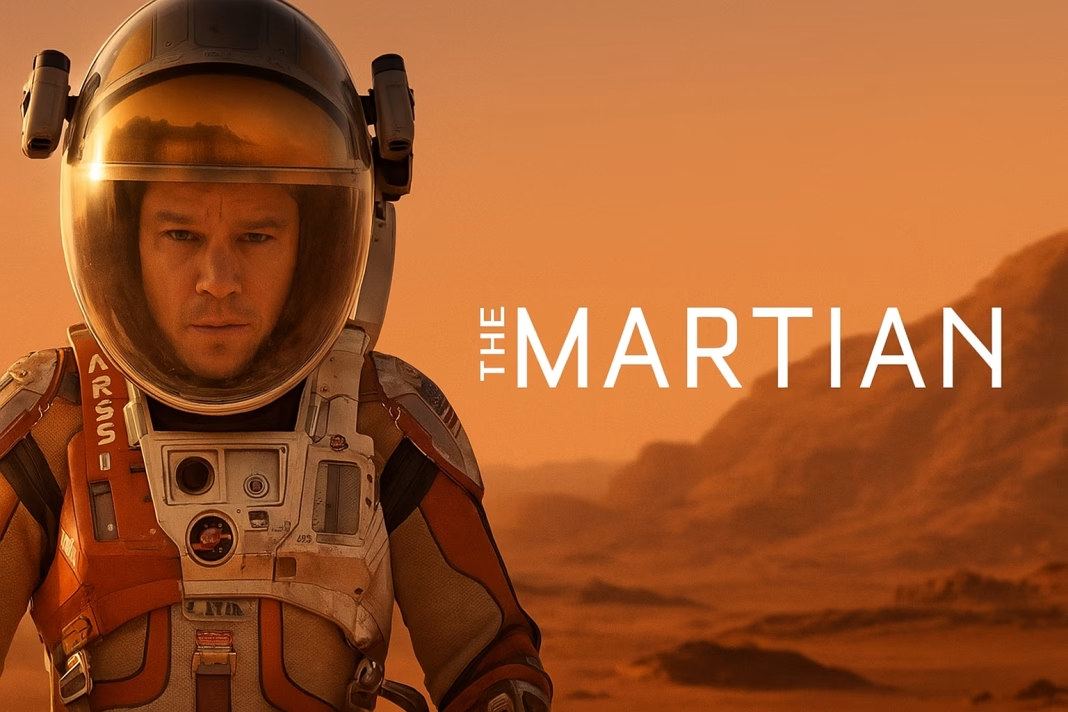

When Ridley Scott gets the right script in his hands, something magical happens. The Martian is proof of that. After a run of visually impressive but narratively uneven projects like Prometheus and Exodus: Gods and Kings, Scott finds himself back in familiar territory — crafting an immersive world without losing sight of the human story at its core.
Based on Andy Weir’s bestselling novel and adapted for the screen by Drew Goddard, The Martian blends science, survival, and a surprising amount of humour into one of the most entertaining space adventures in years.
A Stranded Astronaut With a Will to Live
Matt Damon plays Mark Watney, a NASA botanist who’s left behind on Mars after a sudden, fierce windstorm forces his crew to abort their mission. Presumed dead, he wakes to find himself alone on a planet where help is millions of miles away and years from arriving.
Watney’s situation could easily have been the setup for a slow, brooding drama. Instead, the film finds energy in his determination to survive. He records video logs, talks to himself, and tackles every problem with a mix of dry wit and scientific curiosity. His approach to survival — “I’m going to have to science the hell out of this” — gives the film a refreshing, optimistic tone.
One of the most memorable sequences shows him turning a cramped Mars habitat into a potato farm using leftover rations, soil, and his own waste. It’s as absurd as it is inspiring, a moment that captures the film’s central theme: humans can improvise their way through almost anything.
A Balance of Tension, Humour, and Teamwork
The beauty of The Martian lies in its balance. Yes, Watney’s predicament is tense, but Scott and Goddard avoid turning it into relentless doom and gloom. Instead, the film thrives on moments where science becomes a puzzle to be solved, and where humour cuts through the isolation. Damon’s charisma makes us root for him instantly, but the film also widens its scope beyond Mars.
Back on Earth, NASA’s leadership (Jeff Daniels, Chiwetel Ejiofor, Kristen Wiig) debate rescue strategies, public relations, and the ethics of risk. Meanwhile, aboard the Hermes spacecraft, Watney’s crewmates — led by Jessica Chastain’s calm and quietly determined commander — wrestle with guilt and the possibility of a daring, unsanctioned rescue.
This shifting perspective keeps the story dynamic. It’s not just a lone survival tale; it’s a story about teamwork stretched across millions of miles, about how collaboration can exist even when separated by time delays and planetary distance.
Ridley Scott’s Vision Meets Real-World Science
Visually, The Martian is stunning without being overly self-indulgent. Cinematographer Dariusz Wolski captures the Martian landscape in warm ochres and reds, filmed on location in Jordan’s Wadi Rum and combined with intricate set work in Budapest. The result is a Mars that feels both alien and oddly familiar — a place you can imagine living in, if you had no choice.
The production design hits that sweet spot between NASA precision and the lived-in feel of a makeshift outpost. There’s a tactile quality to the film — the duct tape repairs, the scratched-up helmets, the cramped spaces — that recalls Apollo 13 and even Alien. The technology looks advanced yet believable, and the science, while simplified for storytelling, is convincing enough to inspire curiosity.
And then there’s the soundtrack. In a clever bit of character detail, Watney’s only music is his commander’s stash of disco hits. The juxtaposition of Donna Summer or ABBA against scenes of Martian farming or problem-solving gives the film a quirky rhythm, much like Guardians of the Galaxy’s retro mixtape charm.
Why The Martian Stands Out
What makes The Martian truly stand out is its tone. Unlike many recent sci-fi films that dwell on dystopian despair or heavy philosophical musings, this one celebrates human ingenuity. It acknowledges danger but focuses on solutions. There’s satisfaction in watching problems get solved with creativity, resilience, and, yes, duct tape.
Damon delivers one of his most engaging performances, carrying large stretches of the film solo while making Watney’s isolation both relatable and entertaining. The supporting cast is equally strong, even with limited screen time, each character adding weight to the mission to bring him home.
Scott’s direction feels lighter and more playful than in years past, without sacrificing tension. It’s as though he’s rediscovered the joy of telling a good, straightforward story — one that connects on a human level.
Final Thoughts
The Martian is Ridley Scott’s most crowd-pleasing film in years, a rare blend of high-stakes drama, smart humour, and visual spectacle. It works as an adventure, a survival story, and even a light-hearted ode to problem-solving. Beneath its sci-fi exterior, it’s a celebration of human optimism — the belief that even when faced with the impossible, we can think, build, and laugh our way toward a solution.
It’s not just a movie about surviving on Mars; it’s about surviving anywhere — with the right mix of knowledge, creativity, and determination. And that’s why, years after its release, The Martian still feels fresh, hopeful, and immensely rewatchable.