

Spaceman Review: A Cosmic Tale That Balances Loneliness and Wonder

At its core, Spaceman is not just a science fiction film about astronauts or distant galaxies. It is a story of human fragility told through the vast backdrop of space.

A Universe Built on Isolation

Director Johan Renck crafts a world where silence speaks louder than explosions and where loneliness carries more weight than meteor showers. Unlike many big-budget space movies that rely heavily on visual effects and intergalactic spectacles, Spaceman leans into quiet despair and emotional turbulence.

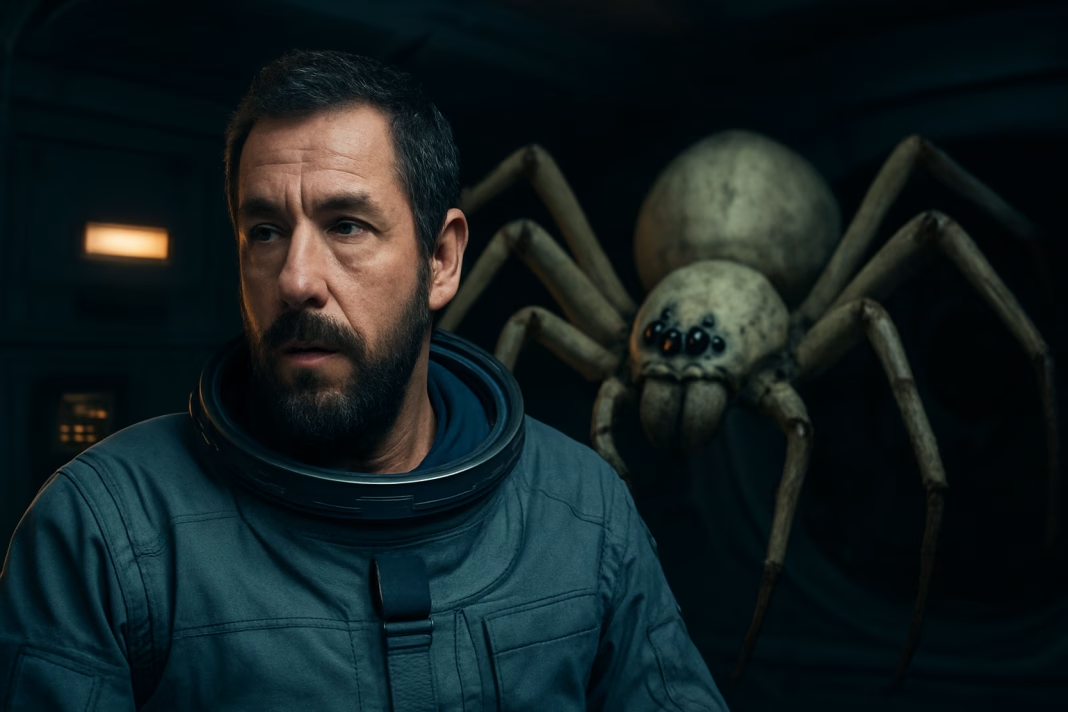
The film follows Jakub Procházka, played with aching sincerity by Adam Sandler, who delivers one of the most unexpected performances of his career. Far removed from his usual comedic roles, Sandler embodies a man swallowed by isolation. Alone on a mission at the edge of the solar system, Jakub finds himself not battling alien armies but confronting the emptiness of space and the wreckage of his crumbling marriage back on Earth.

This is where the film becomes more than just another space drama. Renck’s direction ensures that the universe itself feels like a mirror, reflecting Jakub’s inner turmoil. The darkness of the cosmos becomes a metaphor for abandonment, regret, and longing. In this way, Spaceman forces the audience to consider how much of the “final frontier” is truly out there, and how much of it lives within us.

The Spider That Holds the Soul Together

No review of Spaceman can overlook its most audacious creative choice: the talking alien spider. Voiced with mystical gravitas by Paul Dano, the creature could have easily been a gimmick. Instead, it becomes the soul of the film. The spider—both terrifying and oddly comforting—functions as Jakub’s therapist, philosopher, and confessor. It is not there to frighten, but to peel back layers of human vulnerability.

For a critic, this is where the film shows its daring spirit. The spider is not simply an extraterrestrial; it is a projection of Jakub’s deepest fears and hidden truths. As the conversations between the two unfold, audiences realize that the creature is less about science fiction and more about the human psyche. It draws Jakub into confronting his failures as a husband and as a man, forcing him to recognize the emotional distance that grew even before the physical distance of space.

Paul Dano’s voice performance gives the spider a chilling yet oddly compassionate presence. Its calm, deliberate tone adds to the unsettling intimacy of their exchanges. This surreal companionship becomes the emotional anchor of the film, keeping Jakub tethered to sanity while amplifying the tension between the infinite emptiness outside and the deep, unresolved pain within.

What makes this device work so brilliantly is how it destabilizes the audience. Viewers never quite know if the spider is real, imagined, or some combination of both. That uncertainty adds layers to the narrative, transforming Spaceman into a meditation on grief, guilt, and human connection disguised as a cosmic odyssey.

Between Earth and the Infinite

While much of the film unfolds within the claustrophobic walls of Jakub’s spacecraft, the heartache lies back on Earth. His wife Lenka, played with quiet restraint by Carey Mulligan, is not reduced to a distant figure in distress. Instead, she represents the reality Jakub cannot escape. Their marriage, strained by absence and unspoken resentment, is the true battlefield of the story. Every flashback and memory grounds the film, reminding audiences that even the grandest missions can be undone by emotional neglect.

Cinematographer Jakob Ihre deserves recognition for the way he shoots both space and Earth. The spacecraft interiors are stark, cold, and metallic, amplifying Jakub’s sense of entrapment. In contrast, the Earth sequences glow with warmth, creating a painful reminder of what he has lost. These visual contrasts underline the emotional dichotomy of the film—freedom versus confinement, intimacy versus isolation, home versus the infinite.

Critically, Spaceman may not please everyone. Viewers expecting interstellar battles or adrenaline-fueled sequences may find the pacing slow. But for those willing to engage with its philosophical undertones, the film offers a rewarding meditation on what it means to be human. It draws more inspiration from Tarkovsky’s Solaris than Nolan’s Interstellar, positioning itself firmly within the tradition of cerebral, existential science fiction.

As the credits roll, what lingers is not the spectacle of space travel, but the ache of disconnection. The film insists that space is not only a place of discovery but also of reckoning—a place where humans cannot run from themselves.


Prasad Bhidey
Prasad Bhidey
Prasad Bhidey is the space enthusiast. He is the Editor of Spacetechtimes - A dedicated publication on Space related news and updates. He is also fond of Sci-fi movies and writes a series of reviews on science fiction movies exclusively for Newsinterpretation.

TOP 10 TRENDING ON NEWSINTERPRETATION

Cyber Attacks on Space Infrastructure: Satellites, GPS and the Ground Systems Behind Them

From the Viasat KA-SAT hack to GPS jamming over the Baltic, a research guide to how attackers target satellites, navigation signals and ground stations, and why it matters on Earth.

How AI Agents Are Used in Cyber Attacks: From Assisted Hacking to AI-Orchestrated Espionage

Attackers now use AI agents to scan networks, write exploits and run extortion campaigns. A research guide to documented cases, including the first reported AI-orchestrated espionage campaign, and what defenders should do.

Cyber Attacks on AI and LLMs: How Attackers Target Large Language Models

Prompt injection, data poisoning, model theft and jailbreaks: a research guide to how attackers target AI systems and large language models, with real cases and defences.

French Supermarket Refrigeration Cyberattack: How Hacking the Cold Chain Can Endanger Lives

In October 2026 attackers heated refrigeration cabinets in hundreds of French supermarkets to as much as 50°C. No one was hurt, but the attack shows how hacking the cold chain can endanger lives through fire, food poisoning and spoiled medicines.

Cyberattacks on Nuclear Facilities: Stuxnet, Kudankulam and the Limits of Air Gaps

Stuxnet, the Davis-Besse worm and malware at India’s Kudankulam plant: what they show about cyber risk at nuclear facilities and the limits of air gaps.

Triton: When Hackers Target the Safety Systems That Prevent Industrial Disasters

The 2017 Triton attack targeted the safety systems that prevent industrial disasters. What happened, who was charged, and how plants protect their last line of defence.

Cybersecurity Risks in Smart Cities: When Connected Infrastructure Fails

How connecting traffic control, emergency alerts and utilities concentrates cyber risk in cities, what the Dallas and Atlanta incidents showed, and what governments recommend.

Weaponized Drones: Hijacking, GPS Spoofing and Emerging Cyber Warfare Risks

How drones can be hijacked, jammed or misled by GPS spoofing, what researchers have demonstrated, and why governments treat drone fleets as a security risk.

Ransomware Attacks on Hospitals: How Healthcare Cyberattacks Put Patients at Risk

How ransomware against hospitals and their suppliers delays care and endangers patients, what the Düsseldorf and WannaCry cases show, and what research says about deaths.

Operational blunder exposes massive Russian cyber espionage attack on Ukrainian prosecutors

A major cyberattack has compromised the email accounts of...

Cyber Attacks on Space Infrastructure: Satellites, GPS and the Ground Systems Behind Them

From the Viasat KA-SAT hack to GPS jamming over the Baltic, a research guide to how attackers target satellites, navigation signals and ground stations, and why it matters on Earth.

French Supermarket Refrigeration Cyberattack: How Hacking the Cold Chain Can Endanger Lives

In October 2026 attackers heated refrigeration cabinets in hundreds of French supermarkets to as much as 50°C. No one was hurt, but the attack shows how hacking the cold chain can endanger lives through fire, food poisoning and spoiled medicines.

Cyberattacks on Nuclear Facilities: Stuxnet, Kudankulam and the Limits of Air Gaps

Stuxnet, the Davis-Besse worm and malware at India’s Kudankulam plant: what they show about cyber risk at nuclear facilities and the limits of air gaps.

Triton: When Hackers Target the Safety Systems That Prevent Industrial Disasters

The 2017 Triton attack targeted the safety systems that prevent industrial disasters. What happened, who was charged, and how plants protect their last line of defence.

Cybersecurity Risks in Smart Cities: When Connected Infrastructure Fails

How connecting traffic control, emergency alerts and utilities concentrates cyber risk in cities, what the Dallas and Atlanta incidents showed, and what governments recommend.

Ransomware Attacks on Hospitals: How Healthcare Cyberattacks Put Patients at Risk

How ransomware against hospitals and their suppliers delays care and endangers patients, what the Düsseldorf and WannaCry cases show, and what research says about deaths.

FBI warns of AVrecon malware targeting outdated routers linked to proxy based cybercrime

A serious cybersecurity warning has been issued regarding commonly...

Related Articles

Popular Categories
