

South Korea Wildfires Leave Four Dead and Thousands Homeless

Wildfires Rage Across South Korea, Leaving a Trail of Destruction

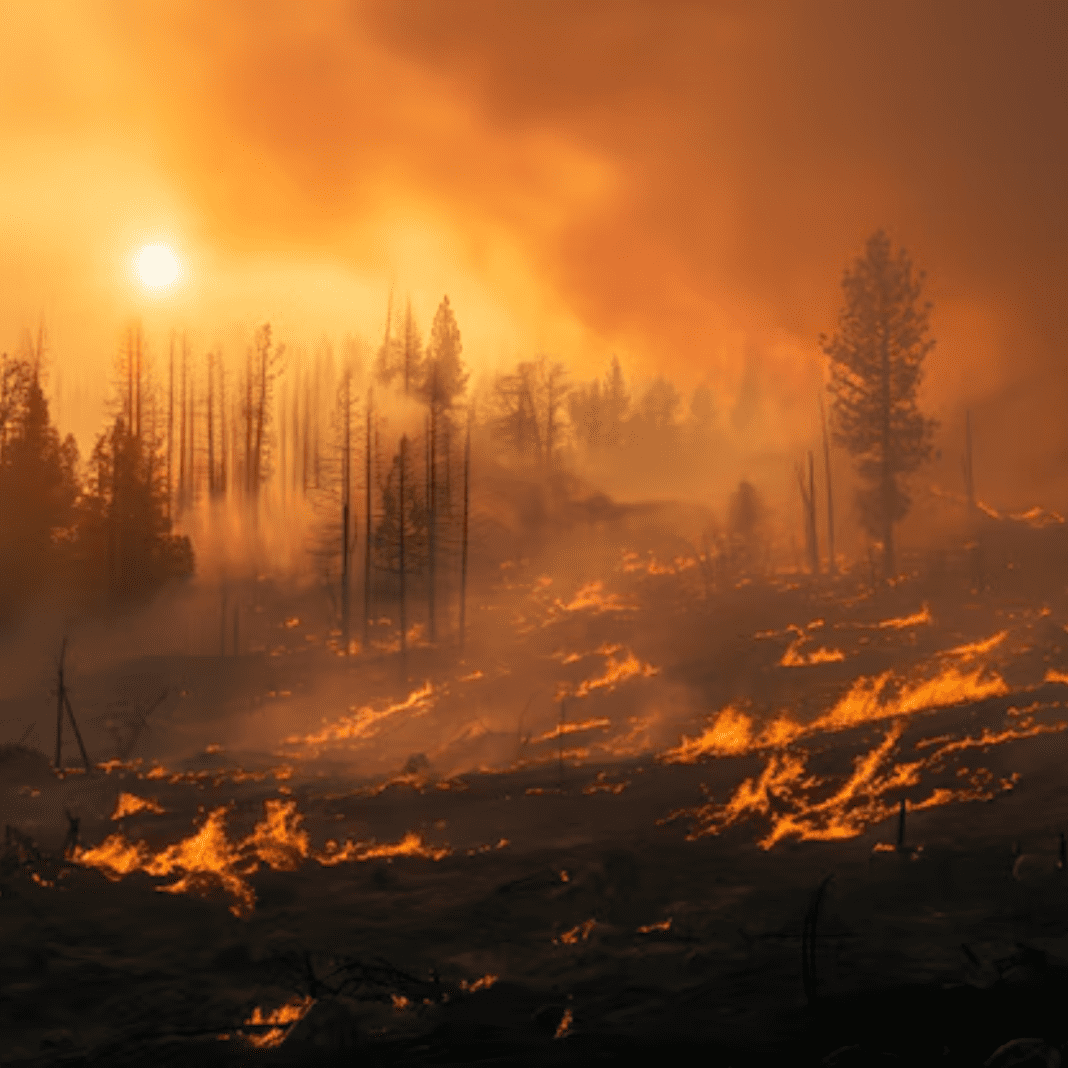
The southeastern region of South Korea is battling its worst wildfires in years. Strong winds and dry weather have fueled the flames, spreading them quickly. The fires have scorched large areas of land, leaving behind massive destruction.

In the past five days, the wildfires have killed four people, including three firefighters. Thousands of people have fled their homes to escape the flames.

The fires started last Friday and spread quickly. They hit areas like Uiseong, Sancheong, and Ulsan. More than 30 wildfires broke out, destroying forests, homes, and farms.

So far, the flames have burned over 36,300 acres of land. The government has declared the worst-hit areas as disaster zones.

Firefighters Make Progress, but the Fight Isn’t Over

After five days of fighting the flames, South Korean firefighters made good progress. By Tuesday morning, they had contained 90% of the fires in Sancheong and Uiseong.

In Ulsan, they brought more than half of the wildfire under control.

Thousands of firefighters and emergency workers, aided by military personnel, have been working around the clock to combat the fires. Despite their efforts, the disaster has already taken a heavy toll.

On Saturday, four individuals, including three firefighters and one government worker, were tragically killed in Sancheong when they were trapped by fast-moving flames.

At least 11 other people have been injured, some suffering from severe burns and smoke inhalation.

In addition to the human toll, the fires have caused widespread property damage. More than 150 buildings have been destroyed or damaged, including homes, warehouses, and farm structures. The devastation has forced over 5,400 people to flee their homes and seek shelter in temporary evacuation centers.

How Cyber Attacks on Industrial Control Systems Can Endanger Lives ?

Disaster Declarations and Government Response

To manage the crisis, the South Korean government declared several areas as disaster zones. This includes parts of South Gyeongsang, Ulsan, and North Gyeongsang.

The disaster label allows the government to give more money and send more resources for firefighting and recovery.

Prime Minister Han Duck-soo, who is currently serving as the country’s acting leader, has vowed to make an all-out effort to control the wildfires. He has called for increased public vigilance, warning that the dry spring weather could lead to more outbreaks.

Critical Vulnerabilities: The Dark Side of Pacemaker Technology

Authorities believe that human error may have caused several of the recent wildfires. In some cases, they suspect the fires were started by people using flames to clear overgrown grass around family tombs. In other instances, sparks from welding work may have ignited the dry vegetation. Investigations are underway to confirm the causes.

Wildfires are not uncommon in South Korea, especially during the dry months of February, March, and April. However, the scale and intensity of these recent blazes have been particularly destructive, making it one of the deadliest wildfire incidents in recent years.

As firefighters continue their battle against the remaining flames, thousands of people are left hoping for swift containment and the beginning of recovery efforts.


Cyber Attacks on Connected Cars

Renuka Bangale
Renuka Bangale
Renuka is a distinguished Chartered Accountant and a Certified Digital Threats Analyst from Riskpro, renowned for her expertise in cybersecurity. With a deep understanding of cybercrimes, malware, cyber warfare, and espionage, she has established herself as an authority in the field. Renuka combines her financial acumen with advanced knowledge of digital threats to provide unparalleled insights into the evolving landscape of information security. Her analytical prowess enables her to dissect complex cyber incidents, offering clarity on risks and mitigation strategies. As a key contributor to Newsinterpretation’s information security category, Renuka delivers authoritative articles that educate and inform readers about emerging threats and best practices.

TOP 10 TRENDING ON NEWSINTERPRETATION

Cyber Attacks on Space Infrastructure: Satellites, GPS and the Ground Systems Behind Them

From the Viasat KA-SAT hack to GPS jamming over the Baltic, a research guide to how attackers target satellites, navigation signals and ground stations, and why it matters on Earth.

How AI Agents Are Used in Cyber Attacks: From Assisted Hacking to AI-Orchestrated Espionage

Attackers now use AI agents to scan networks, write exploits and run extortion campaigns. A research guide to documented cases, including the first reported AI-orchestrated espionage campaign, and what defenders should do.

Cyber Attacks on AI and LLMs: How Attackers Target Large Language Models

Prompt injection, data poisoning, model theft and jailbreaks: a research guide to how attackers target AI systems and large language models, with real cases and defences.

French Supermarket Refrigeration Cyberattack: How Hacking the Cold Chain Can Endanger Lives

In October 2026 attackers heated refrigeration cabinets in hundreds of French supermarkets to as much as 50°C. No one was hurt, but the attack shows how hacking the cold chain can endanger lives through fire, food poisoning and spoiled medicines.

Cyberattacks on Nuclear Facilities: Stuxnet, Kudankulam and the Limits of Air Gaps

Stuxnet, the Davis-Besse worm and malware at India’s Kudankulam plant: what they show about cyber risk at nuclear facilities and the limits of air gaps.

Triton: When Hackers Target the Safety Systems That Prevent Industrial Disasters

The 2017 Triton attack targeted the safety systems that prevent industrial disasters. What happened, who was charged, and how plants protect their last line of defence.

Cybersecurity Risks in Smart Cities: When Connected Infrastructure Fails

How connecting traffic control, emergency alerts and utilities concentrates cyber risk in cities, what the Dallas and Atlanta incidents showed, and what governments recommend.

Weaponized Drones: Hijacking, GPS Spoofing and Emerging Cyber Warfare Risks

How drones can be hijacked, jammed or misled by GPS spoofing, what researchers have demonstrated, and why governments treat drone fleets as a security risk.

Ransomware Attacks on Hospitals: How Healthcare Cyberattacks Put Patients at Risk

How ransomware against hospitals and their suppliers delays care and endangers patients, what the Düsseldorf and WannaCry cases show, and what research says about deaths.

Operational blunder exposes massive Russian cyber espionage attack on Ukrainian prosecutors

A major cyberattack has compromised the email accounts of...

Cyber Attacks on Space Infrastructure: Satellites, GPS and the Ground Systems Behind Them

From the Viasat KA-SAT hack to GPS jamming over the Baltic, a research guide to how attackers target satellites, navigation signals and ground stations, and why it matters on Earth.

French Supermarket Refrigeration Cyberattack: How Hacking the Cold Chain Can Endanger Lives

In October 2026 attackers heated refrigeration cabinets in hundreds of French supermarkets to as much as 50°C. No one was hurt, but the attack shows how hacking the cold chain can endanger lives through fire, food poisoning and spoiled medicines.

Cyberattacks on Nuclear Facilities: Stuxnet, Kudankulam and the Limits of Air Gaps

Stuxnet, the Davis-Besse worm and malware at India’s Kudankulam plant: what they show about cyber risk at nuclear facilities and the limits of air gaps.

Triton: When Hackers Target the Safety Systems That Prevent Industrial Disasters

The 2017 Triton attack targeted the safety systems that prevent industrial disasters. What happened, who was charged, and how plants protect their last line of defence.

Cybersecurity Risks in Smart Cities: When Connected Infrastructure Fails

How connecting traffic control, emergency alerts and utilities concentrates cyber risk in cities, what the Dallas and Atlanta incidents showed, and what governments recommend.

Ransomware Attacks on Hospitals: How Healthcare Cyberattacks Put Patients at Risk

How ransomware against hospitals and their suppliers delays care and endangers patients, what the Düsseldorf and WannaCry cases show, and what research says about deaths.

FBI warns of AVrecon malware targeting outdated routers linked to proxy based cybercrime

A serious cybersecurity warning has been issued regarding commonly...

Related Articles

Popular Categories
