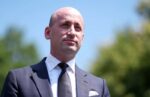
A fiery scene unfolded at the White House when Press Secretary Karoline Leavitt clashed with a reporter who questioned her about growing concerns over crime in Portland. The exchange, which quickly turned tense, drew strong reactions from the public after a video clip circulated online showing Leavitt visibly frustrated during the confrontation.
Heated Press Room Exchange Sparks Outrage
The reporter had asked what steps the administration planned to take after a federal judge blocked the president from deploying National Guard troops to Oregon. The legal order followed a fast-moving situation in which the president had first tried to mobilize Oregon’s own National Guard, and when stopped by the court, immediately moved to deploy troops from California instead.
The judge’s temporary restraining order stopped the plan within hours. She emphasized that the government’s justification for sending troops was “untethered to what was actually happening on the ground.”
During the press briefing, the reporter pressed Leavitt about whether any local officials in Portland had actually requested federal troops. “Which local officials in Portland have said that the National Guard is needed there, if any?” the journalist asked.
Leavitt fired back, “With all due respect to that judge, I think her opinion is untethered in reality and in the law. We are appealing that decision, and we’re very confident in the president’s legal authority to do this.” She added that the administration expected a hearing soon and believed it would win based on legal grounds.
But the back-and-forth didn’t stop there. The reporter followed up by noting that Portland’s police chief had said the city didn’t need National Guard troops and that conditions there didn’t match the administration’s claims.
Leavitt’s Angry Response Draws Attention
Leavitt’s tone turned sharp as she challenged the reporter to “go on the ground” and see the situation for herself. “There have been many members of the press, not press in this room, but independent journalists, who have been in the middle of these riots and witnessed the anarchy taking place night after night,” she said.
She continued, “It’s on video. You should play it on your show. You have a great opportunity in primetime to show your audience what’s really happening.” Leavitt also accused the reporter of relying on “partisan Democrat officials who are opposed to everything this president does.”
✈️ Qatar’s $400M Jet Gift Sparks White House Fury—Air Force One Deal Caught in Political Crossfire
Her remarks quickly made headlines, as social media users began sharing the clip. Some praised her for standing firm, while others accused her of spreading misinformation and being disrespectful. The phrase “pathetic liar” began trending online as critics blasted her comments and behavior.
One user wrote that the reporter “kept calm, kept pushing back, and never let the spin go unchallenged.” Another commented that Leavitt should “visit Portland herself to see that the president’s claims don’t match what’s actually happening.”
However, not everyone was critical. Supporters of Leavitt argued that she was “calling it like it is” and that the press had ignored what was really happening in the city. Some accused the reporter of bias and defended Leavitt’s aggressive stance as justified given the line of questioning.
Legal Dispute Over National Guard Deployment
Behind the heated exchange lies a larger legal battle between the federal government and state authorities in Oregon and California. On Sunday, U.S. District Judge Karin Immergut issued a temporary restraining order stopping the president from sending National Guard troops into Oregon. The ruling came after both Oregon and California challenged the deployment as unconstitutional and unnecessary.
The judge expressed disbelief that, despite her order, the administration had attempted to send troops from California and Texas to Oregon just hours later. “How could bringing in federalized National Guard from California not be in direct contravention to the temporary restraining order I issued yesterday?” she asked in court.
Oregon’s officials are fighting to keep federalized troops out of the state’s largest city, where small protests have been taking place outside an immigration processing facility since the beginning of the president’s second term. Although there have been occasional flare-ups, local law enforcement reported that recent demonstrations have been peaceful and limited to a small area far from the downtown.
Karoline Leavitt shares post linking Utah earthquake to Charlie Kirk death timing
Local leaders also pointed out that some of the administration’s claims about the city being “war ravaged” or “burning down” were based on images from 2020, when large-scale unrest took place during the nationwide protests linked to the Black Lives Matter movement. Under the city’s new leadership, officials say that crime has gone down, homeless encampments have decreased, and the downtown area has started to recover.
Still, the president has continued to describe Portland as a “war zone,” arguing that federal action is needed to restore order. His statements have intensified the political debate around the use of federal forces in states that oppose such moves.
As the situation unfolds, Leavitt’s outburst has become a focal point in the ongoing conversation about political messaging, public perception, and the tension between the federal government and local authorities.