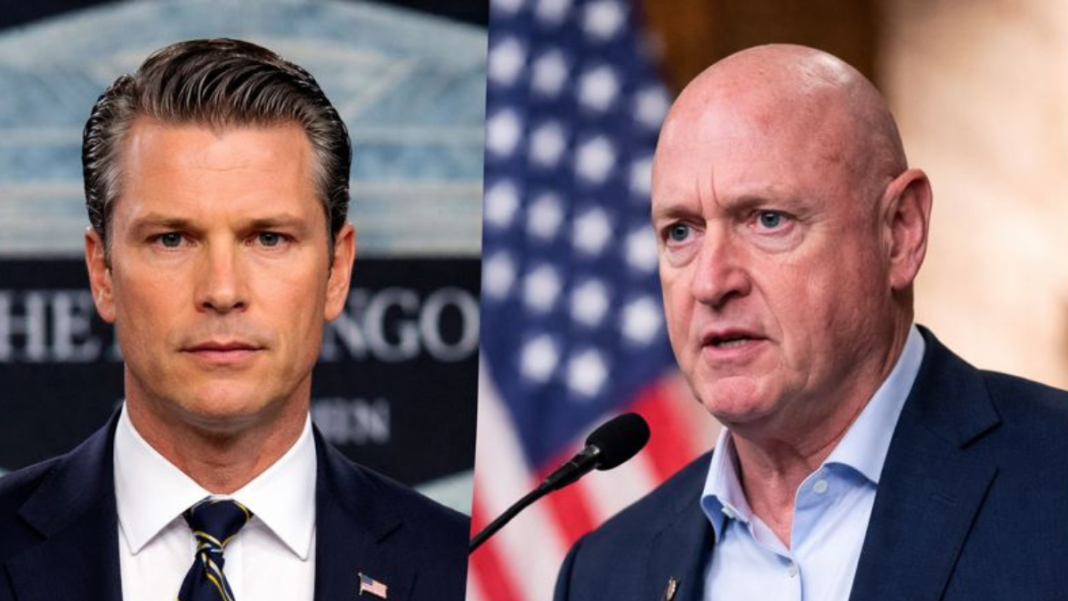

Pentagon chief Hegseth is facing a serious legal challenge after a former Navy officer and current U.S. senator, Mark Kelly, filed a lawsuit accusing him of unconstitutional retaliation. The case centers on actions taken against Kelly after he participated in a public video urging U.S. military members to refuse illegal orders.
Kelly, who served 25 years in the Navy and retired as a captain in 2011, says his constitutional rights were violated when Hegseth moved to downgrade his military retirement rank and reduce his pension. The lawsuit was filed in the U.S. District Court for the District of Columbia and lists Hegseth, Navy Secretary John Phelan, and the Department of Defense as defendants.
The conflict began last November when Kelly joined five other Democratic lawmakers—Elissa Slotkin, Jason Crow, Chrissy Houlahan, Chris Deluzio, and Maggie Goodlander—in releasing a video message during rising military tensions involving U.S. operations near Venezuela. All six lawmakers have backgrounds in the military or intelligence community.
In the video, the group addressed service members directly, acknowledging the pressure they face and reminding them of their oath to defend the Constitution. They told viewers that Americans trust the military, but that trust was at risk, and clearly stated that service members have the right to refuse illegal orders.
Retirement Rank Downgrade Sparks Free Speech and Military Authority Dispute
Soon after the video was released, former President Donald Trump publicly accused the lawmakers of “sedition” and called their behavior punishable by death. According to the lawsuit, Hegseth reacted strongly as well. He allegedly threatened to court-martial Kelly and later took the unprecedented step of reducing Kelly’s retirement rank and pay.
Kelly argues that this punishment was not only unlawful but also completely without precedent. He points out that none of the other five lawmakers faced similar action because they do not receive military retirement pay. As a retired Navy captain who still draws a pension, Kelly says his benefits were used as leverage to silence him.
In a public message on X, Hegseth stated that Kelly remains accountable to military justice and that the Department of War and the American people expect “justice.” Kelly’s legal filing strongly disputes this claim, stating that the actions were politically motivated and legally baseless.
Trump loses Nobel Peace Prize — Venezuela’s María Corina Machado takes the honor
The lawsuit warns that these actions create a “chilling effect” for military veterans across the country. It argues that if a retired officer can lose rank and pay for political speech years after leaving service, then all veterans could feel pressured to stay silent.
Case Raises Alarm Over Political Punishment of Retired Service Members
The case also highlights the broader political context surrounding U.S. military operations. At the time of the video, the Trump administration had justified deadly strikes on alleged drug boats by claiming it was fighting “narco-terrorists.” Since then, U.S. forces have captured Venezuelan leader Nicolas Maduro, and Trump has openly stated his plan to control Venezuela’s future and seize its oil as part of U.S. dominance in the Western Hemisphere.
Kelly’s lawsuit states that in the entire history of the nation, the Executive Branch has never imposed military punishment on a sitting member of Congress for political speech. It argues that Hegseth and the Defense Department abused military authority in order to punish criticism of government policy.
The complaint further explains that these actions send a dangerous message to both lawmakers and retired service members. It suggests that criticizing the government’s use of the armed forces could result in retaliation through military channels.
Legal filings describe the conduct of Hegseth as unconstitutional and without legal foundation. They argue that the Constitution protects political speech and that military power cannot be used as a political weapon.
Trump orders maritime blockade focused on sanctioned Venezuelan oil tankers
The Department of Defense has been contacted for comment by multiple outlets, including The Daily Beast, but no official response has been provided so far.
At the center of the case is the question of whether retired service members who hold public office can be punished by the military for political views. Kelly insists the Constitution offers clear protection. His lawsuit asks the court to block the actions taken by Hegseth and restore his rank and benefits.
The case now places Hegseth, the Pentagon, and the wider executive branch under close legal examination as the court reviews whether military authority was misused to silence political opposition.