

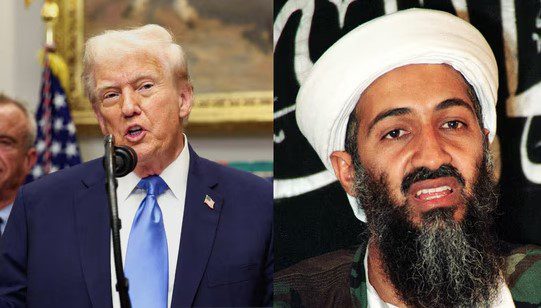
Trump reignites 9/11 controversy — claims he warned about Osama bin Laden a year before the attacks

U.S. President Donald Trump once again drew attention to his long-standing claim that he warned about Osama bin Laden before the September 11 attacks. Speaking on Sunday at a ceremony celebrating the Navy’s 250th anniversary, Trump recounted his statement from his book published in 2000.

Trump Repeats Years-Old Claim at Navy Event

“I wrote about Osama bin Laden exactly one year before he blew up the World Trade Center, and I said, ‘You got to watch Osama bin Laden,’” Trump said. He struggled to recall the title of his book, adding, “whatever the hell the title, I can’t tell you.”

Trump emphasized a page in the book where he mentioned Laden. “I saw somebody named Osama bin Laden, and I didn’t like it, and you gotta take care of him. They didn’t do it. A year later, he blew up the World Trade Center,” the former president said. He added that credit was not being given to him, so he had to take it himself.

U.S. Treasury’s Trump coin proposal for America’s 250th anniversary sparks fierce political backlash

This is not the first time Trump has highlighted this claim. Since publishing The America We Deserve, Trump has repeatedly pointed to his mention of Laden as a sign of foresight regarding future terrorist attacks in the United States. Over the years, he has used this narrative to portray himself as unusually alert to emerging threats.

Observers noted that Trump’s retelling at the Navy event followed a familiar pattern: blending personal anecdotes, historical references, and claims of foresight. His remarks came alongside praise for the Navy’s service and achievements, but the focus quickly shifted to his assertion of having anticipated one of the most devastating attacks in U.S. history.

What Trump Actually Wrote About Bin Laden

While Trump’s speeches suggest he was warning that Laden should be killed, his book presents a different account. In The America We Deserve, Trump described Laden as a “shadowy figure with no fixed address” who became public enemy number one. He noted that U.S. jet fighters laid waste to bin Laden’s camp in Afghanistan, but the militant leader escaped.

Nowhere in the book does Trump explicitly call for bin Laden to be eliminated. Instead, he wrote about bin Laden as one of many global threats the United States might confront over time. The book portrays bin Laden’s rise as a concern but does not suggest a concrete strategy to counter him directly.

Trump’s $28 billion funding freeze for Democratic states raises constitutional red flags

Trump’s interpretation of his own book contrasts sharply with the historical record. Laden orchestrated the September 11, 2001 attacks, which killed nearly 3,000 people in New York City, Washington D.C., and Pennsylvania. The terrorist leader remained at large for nearly a decade until he was killed by U.S. Navy SEALs in Pakistan in 2011.

Experts have highlighted that Trump’s claim overstates the significance of his book’s content. While it is true that he mentioned bin Laden, there was no explicit warning or actionable plan outlined to prevent the attacks. Fact-checkers note that the president’s narrative tends to amplify the foresight implied in his earlier writings.

Trump Compares Bin Laden to Other Terror Figures

Trump has previously downplayed Laden’s impact while highlighting other terrorist leaders killed during his presidency. In a 2021 interview, he remarked that bin Laden had “one hit,” referring to the 9/11 attacks.

He contrasted this with the deaths of Abu Bakr al-Baghdadi, the leader of ISIS, and Iranian military commander Qasem Soleimani. “These other two guys were monsters. They were monsters,” Trump said. He further suggested that Soleimani was “bigger by many, many times” than bin Laden, underscoring his perspective that his administration dealt with more significant threats.

Trump deploys 400 Texas National Guard members to Illinois and Oregon — JB Pritzker calls it ‘a direct invasion’

Trump’s repeated claims about his foresight on bin Laden continue to attract media coverage. Journalists and political analysts frequently note that his statements exaggerate the actual content of his book. Despite this, the former president continues to reference the narrative in speeches and interviews, portraying himself as an individual who identified threats before they became headline news.

By revisiting these claims, Trump combines historical reflection with personal commentary, often drawing attention during public appearances. Whether viewed as self-promotion or historical recollection, his remarks about bin Laden remain a notable part of his public persona and rhetorical style.
Saquib Panjwani
Saquib Panjwani
Saquib Panjwani is a finance professional with keen interest in subjects like frauds, forensic accounting and finance.

TOP 10 TRENDING ON NEWSINTERPRETATION

Cyber Attacks on Space Infrastructure: Satellites, GPS and the Ground Systems Behind Them

From the Viasat KA-SAT hack to GPS jamming over the Baltic, a research guide to how attackers target satellites, navigation signals and ground stations, and why it matters on Earth.

How AI Agents Are Used in Cyber Attacks: From Assisted Hacking to AI-Orchestrated Espionage

Attackers now use AI agents to scan networks, write exploits and run extortion campaigns. A research guide to documented cases, including the first reported AI-orchestrated espionage campaign, and what defenders should do.

Cyber Attacks on AI and LLMs: How Attackers Target Large Language Models

Prompt injection, data poisoning, model theft and jailbreaks: a research guide to how attackers target AI systems and large language models, with real cases and defences.

French Supermarket Refrigeration Cyberattack: How Hacking the Cold Chain Can Endanger Lives

In October 2026 attackers heated refrigeration cabinets in hundreds of French supermarkets to as much as 50°C. No one was hurt, but the attack shows how hacking the cold chain can endanger lives through fire, food poisoning and spoiled medicines.

Cyberattacks on Nuclear Facilities: Stuxnet, Kudankulam and the Limits of Air Gaps

Stuxnet, the Davis-Besse worm and malware at India’s Kudankulam plant: what they show about cyber risk at nuclear facilities and the limits of air gaps.

Triton: When Hackers Target the Safety Systems That Prevent Industrial Disasters

The 2017 Triton attack targeted the safety systems that prevent industrial disasters. What happened, who was charged, and how plants protect their last line of defence.

Cybersecurity Risks in Smart Cities: When Connected Infrastructure Fails

How connecting traffic control, emergency alerts and utilities concentrates cyber risk in cities, what the Dallas and Atlanta incidents showed, and what governments recommend.

Weaponized Drones: Hijacking, GPS Spoofing and Emerging Cyber Warfare Risks

How drones can be hijacked, jammed or misled by GPS spoofing, what researchers have demonstrated, and why governments treat drone fleets as a security risk.

Ransomware Attacks on Hospitals: How Healthcare Cyberattacks Put Patients at Risk

How ransomware against hospitals and their suppliers delays care and endangers patients, what the Düsseldorf and WannaCry cases show, and what research says about deaths.

Operational blunder exposes massive Russian cyber espionage attack on Ukrainian prosecutors

A major cyberattack has compromised the email accounts of...

Cyber Attacks on Space Infrastructure: Satellites, GPS and the Ground Systems Behind Them

From the Viasat KA-SAT hack to GPS jamming over the Baltic, a research guide to how attackers target satellites, navigation signals and ground stations, and why it matters on Earth.

French Supermarket Refrigeration Cyberattack: How Hacking the Cold Chain Can Endanger Lives

In October 2026 attackers heated refrigeration cabinets in hundreds of French supermarkets to as much as 50°C. No one was hurt, but the attack shows how hacking the cold chain can endanger lives through fire, food poisoning and spoiled medicines.

Cyberattacks on Nuclear Facilities: Stuxnet, Kudankulam and the Limits of Air Gaps

Stuxnet, the Davis-Besse worm and malware at India’s Kudankulam plant: what they show about cyber risk at nuclear facilities and the limits of air gaps.

Triton: When Hackers Target the Safety Systems That Prevent Industrial Disasters

The 2017 Triton attack targeted the safety systems that prevent industrial disasters. What happened, who was charged, and how plants protect their last line of defence.

Cybersecurity Risks in Smart Cities: When Connected Infrastructure Fails

How connecting traffic control, emergency alerts and utilities concentrates cyber risk in cities, what the Dallas and Atlanta incidents showed, and what governments recommend.

Ransomware Attacks on Hospitals: How Healthcare Cyberattacks Put Patients at Risk

How ransomware against hospitals and their suppliers delays care and endangers patients, what the Düsseldorf and WannaCry cases show, and what research says about deaths.

FBI warns of AVrecon malware targeting outdated routers linked to proxy based cybercrime

A serious cybersecurity warning has been issued regarding commonly...

Related Articles

Popular Categories
